Written by the NABOLY Team | Hebron, Palestine | Updated October 26, 2026 | Approximately 13-minute read
Sourcing leather shoes from Palestine can introduce American footwear retailers to manufacturers with generations of experience in leatherworking, shoe construction, and traditional craftsmanship.
Hebron, one of Palestine’s major manufacturing centers, has a longstanding footwear industry that produces leather sandals, loafers, dress shoes, casual footwear, and boots.
For international retailers, however, finding the right products is only one part of the purchasing process.
Businesses also need to understand how wholesale orders are placed, how payments are arranged, which shipping documents may be necessary, and how goods manufactured in Palestine reach customers in the United States.
These questions are particularly important because Palestinian manufacturers operate within a trade environment where transportation routes and border procedures can affect shipment planning.
Can U.S. retailers source leather shoes directly from Palestine? Yes. American shoe stores and distributors can explore direct purchasing relationships with Palestinian footwear manufacturers. Before ordering, buyers should confirm product specifications, commercial terms, payment arrangements, export documentation, transportation responsibilities, and applicable U.S. import requirements.
This guide explains the process step by step, using the practical considerations involved in sourcing footwear from Hebron and the published ordering approach of NABOLY, a Palestinian leather footwear manufacturer.
How Do You Import Shoes From Palestine? The Short Answer
For a U.S. retailer purchasing footwear from a Palestinian manufacturer, the process generally involves seven stages.
| Stage | What Happens |
|---|---|
| 1. Product selection | Choose footwear models, colors, and sizes |
| 2. Wholesale inquiry | Request availability, pricing, quantities, and shipping information |
| 3. Quotation | Review the manufacturer’s proposed commercial terms |
| 4. Order confirmation | Agree on quantities, payment, specifications, and delivery responsibilities |
| 5. Production and packing | Manufacturer prepares and packs the footwear |
| 6. Export and international transportation | Shipment passes through applicable export and transportation procedures |
| 7. U.S. import and delivery | Goods undergo applicable customs entry procedures and are delivered to the buyer |
The precise sequence depends on whether the footwear is already in stock, the terms of sale, and the transportation arrangements.
A small shipment of product samples may require a different logistical approach from a large commercial order.
The most important rule is to confirm the full purchasing and shipping arrangement before payment or production begins.
1. Why Source Leather Shoes From Palestine?
Palestine has a manufacturing history that includes textiles, furniture, stone products, and leather goods.
Within the footwear industry, Hebron is particularly well known for its shoemaking tradition.
The city developed a concentration of leatherworkers, family workshops, footwear factories, and businesses supplying components used in shoe production.
This history gives international buyers a reason to research Hebron when evaluating potential leather footwear manufacturers.
Hebron’s Leather Footwear Manufacturing Heritage
Shoemaking knowledge in Hebron developed across generations.
Traditional manufacturing involved leather selection, pattern cutting, stitching, shaping, sole attachment, and finishing.
As production equipment evolved, local manufacturers introduced machinery while continuing to rely on experienced workers.
Today, the footwear industry includes businesses offering different styles and construction methods.
Our article on Hebron’s shoemaking heritage explains how the city’s footwear industry developed and why leather manufacturing became an important part of its industrial identity.
What Types of Shoes Are Manufactured in Palestine?
Palestinian footwear manufacturers may produce different categories, including:
- Men’s leather sandals
- Fisherman sandals
- Leather slip-ons and loafers
- Dress shoes
- Casual leather shoes
- Women’s sandals
- Children’s footwear
- Leather boots
- Work-related footwear
Not every manufacturer produces all of these categories.
Retailers should review each supplier’s actual collection before deciding whether it suits their business.
For example, NABOLY maintains an online footwear catalog that allows buyers to explore its available product models.
Is Palestinian Footwear Suitable for U.S. Retailers?
The suitability of any footwear collection depends on the products and the store’s customers.
A retailer specializing in leather sandals may focus on comfort, strap construction, material specifications, and size availability.
A store selling leather dress shoes may prioritize a different set of features.
Before purchasing, evaluate the actual footwear rather than assuming that geographic origin alone determines quality.
2. How to Find a Palestinian Shoe Manufacturer
When researching manufacturers in Palestine, begin by identifying companies producing your intended footwear category.
Review their websites, product catalogs, manufacturing information, and business contact details.
A company may sell footwear online without manufacturing every product itself.
For wholesale purchasing, clarify whether you are dealing with the manufacturer, a distributor, or another type of supplier.
Questions to Ask a Potential Manufacturer
Before discussing prices, confirm:
- Where is the footwear manufactured?
- Which footwear categories does the company produce?
- Does the company maintain an identifiable manufacturing operation?
- Which materials are used?
- Does the company accept wholesale inquiries?
- Are product specifications available?
- Can international orders be arranged?
- Who handles export and shipping coordination?
- What are the applicable order requirements?
- How are quality expectations documented?
These questions can help establish whether the manufacturer is suitable for your purchasing needs.
Understanding NABOLY’s Manufacturing Background
NABOLY is a family-rooted leather footwear manufacturer based in Ein Arab, Hebron, Palestine.
Its published company history dates to 1948 and describes several generations of footwear manufacturing experience.
The company combines traditional leatherworking knowledge with modern production methods.
Retailers interested in learning about the company’s manufacturing process can explore the NABOLY Shoe Manufacturing page.
Verify the Products, Not Just the Business
A manufacturer’s history is useful, but retailers should also evaluate its current product collection.
Review footwear models, sizes, upper materials, construction, and intended use.
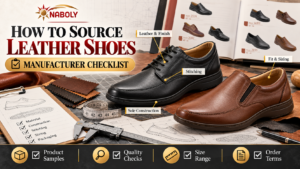
If you’re comparing multiple suppliers, our wholesale shoe manufacturer sourcing checklist explains the broader considerations involved in evaluating direct manufacturing relationships.
3. How to Place a Wholesale Footwear Inquiry From the United States
The first step in an international footwear purchase is usually an inquiry describing your business and the footwear you’re interested in.
For NABOLY, buyers can begin through the company’s Wholesale page.
Providing useful information in the first inquiry allows the manufacturer to respond more accurately.
What Should You Include?
A wholesale inquiry should identify:
Business information: Your store or company name, country, and contact details.
Footwear categories: Leather sandals, loafers, dress shoes, casual shoes, boots, or other relevant collections.
Product models: Specific style numbers if you have already reviewed the catalog.
Estimated quantities: Approximate number of pairs you’re considering.
Sizes: Desired size range and whether you sell primarily to men, women, or children.
Colors: Preferred colors or finishes.
Destination: The country and city where the shipment would be delivered.
Timeline: When you would like the inventory available.
Additional requirements: Any packaging, labeling, or product questions that need to be discussed.
You don’t need every detail finalized before contacting a manufacturer.
However, clear information helps both sides determine whether the proposed order is feasible.
Example Wholesale Inquiry
A U.S. retailer might submit the following information:
| Field | Example |
|---|---|
| Business | Independent footwear retailer |
| Location | Chicago, Illinois, United States |
| Interested products | Men’s leather sandals and loafers |
| Estimated quantity | 100 pairs |
| Colors | Brown and black |
| Sizes | EU 40–45 |
| Product information needed | Catalog, materials, wholesale quotation |
| Shipping destination | Chicago, Illinois |
| Additional questions | Sample availability, payment terms, freight responsibilities |
This is a hypothetical inquiry, not a statement about NABOLY’s minimum order quantities or guaranteed product availability.
How NABOLY Organizes Orders
NABOLY’s published wholesale process describes identifying footwear by model number and specifying color and size breakdowns.
For example, a buyer might request a particular sandal model in brown with separate quantities for EU sizes 40 through 45.
This helps distinguish between the overall order quantity and the quantities needed for individual products.
American retailers should also review our international shoe size conversion guide when planning assortments for U.S. customers.
General conversion tables are useful for reference, but product-specific sizing should be confirmed before ordering.
4. What Happens After You Request a Wholesale Quote?
After receiving an inquiry, a manufacturer can review the requested products and determine which purchasing options are available.
The response may include information about available styles, pricing, quantities, and production or dispatch arrangements.
The details depend on the supplier and order.
What Should a Wholesale Footwear Quotation Include?
A useful quotation identifies the products and commercial terms clearly.
| Quotation Detail | Why It Matters |
|---|---|
| Model numbers | Identifies the footwear being purchased |
| Quantity | Establishes the order volume |
| Size and color breakdown | Confirms the assortment |
| Unit prices | Helps calculate purchasing costs |
| Currency | Clarifies the financial agreement |
| Total product value | Establishes the quoted merchandise cost |
| Payment terms | Explains how and when payment is due |
| Product availability | Determines whether manufacturing is required |
| Dispatch expectations | Supports purchasing schedules |
| Shipping terms | Identifies responsibilities and included services |
| Quote validity | Clarifies how long the offer remains applicable |
The quotation should also identify any special requirements that affect the order.
Why Written Quotations Matter
International transactions can involve several parties, including the buyer, manufacturer, freight forwarder, and customs broker.
Written confirmation helps reduce misunderstandings about what has been purchased and what each party is expected to do.
If the quotation does not explain an important detail, ask for clarification before proceeding.
What About Retail Prices on the Website?
Retail prices displayed in a manufacturer’s public online store are not necessarily wholesale prices.
NABOLY’s published ordering information states that wholesale prices are quoted separately.
Retailers should request the applicable commercial quotation rather than assuming public product prices represent wholesale terms.
For a broader explanation of direct manufacturer purchasing, read our U.S. retailer guide to wholesale leather shoes.
5. How Are Payments Arranged When Buying Shoes From Palestine?
Payment arrangements are among the most important details in an international purchase.
A U.S. retailer and Palestinian manufacturer should agree on the payment method, currency, amount, and timing before the order is finalized.
There is no single payment arrangement used by every Palestinian footwear manufacturer.
Common International Wholesale Payment Methods
International suppliers and buyers may use several commercial payment structures.
Bank transfer
Payment may be sent through an established banking arrangement using verified account details.
The buyer should confirm the beneficiary information, currency, transaction charges, and agreed payment schedule.
Advance payment
Some transactions require payment before production or shipment.
The amount and timing depend on the agreement.
Deposit and balance payment
A contract may provide for an initial payment followed by a remaining balance at an agreed milestone.
The exact terms must be confirmed between buyer and seller.
Letter of credit
Some international transactions use a bank-issued documentary letter of credit.
This arrangement involves specific banking and documentation requirements and may be more complex than a standard transfer.
These are examples of international trade payment arrangements, not a list of payment options confirmed to be offered by NABOLY.
Does NABOLY Require a Deposit?
NABOLY’s publicly available wholesale information does not establish one universal deposit percentage for all orders.
Buyers should request written confirmation of the applicable payment terms.
Do not assume a particular deposit amount or balance schedule before receiving a quotation.
Which Currency Should Be Used?
Before making a payment, confirm the currency stated on the supplier’s quotation or invoice.
Buyers should also consider:
- Currency conversion charges
- International transfer fees
- Receiving-bank fees
- Any intermediary-bank charges
- Who is responsible for those costs
A price expressed in one currency should not be treated as a fixed amount in another currency without confirming the conversion arrangement.
How Can Buyers Reduce Payment Risks?
International payments deserve careful verification.
Before transferring funds:
- Confirm the supplier’s business identity.
- Obtain a written quotation or invoice.
- Verify the recipient’s payment details.
- Confirm the amount and currency.
- Review the payment milestones.
- Keep copies of relevant documents.
- Independently verify unexpected account changes.
If bank details change suddenly, contact the supplier using a previously verified phone number or another established communication channel.
Important: No payment method completely removes commercial risk. The appropriate arrangement depends on the parties, transaction value, banking services, and contract.
6. What Happens When Leather Shoes Are Prepared for Export?
After an order is confirmed and the applicable conditions are satisfied, the footwear must be prepared according to the agreed requirements.
Depending on availability, the manufacturer may fulfill an order from existing stock or prepare products through a manufacturing run.
The exact process can vary.
Product Confirmation
Before packing, the manufacturer and buyer should have agreed on the footwear models, quantities, colors, and sizes.
Any specific packaging or labeling requirements should also be established.
Final Product Inspection
The supplier may inspect completed footwear according to its quality procedures and any agreed buyer requirements.
Common considerations include:
- Correct footwear models
- Accurate size labels
- Quantity and color consistency
- Stitching and finishing
- Visible material condition
- Sole attachment
- Matching left and right shoes
- Packaging accuracy
The inspection should correspond to the products being ordered.
Packaging the Footwear
Footwear may be packed in individual boxes and grouped into larger shipping cartons.
Packaging needs depend on the products, commercial agreement, and transportation method.
For example, an international shipment may require identification of model numbers, carton quantities, weights, and dimensions.
These details help support handling, transportation, and receiving.
Preparing a Packing List
A packing list helps identify what is included in a shipment.
It may contain information such as:
- Carton count
- Product descriptions
- Model numbers
- Quantities
- Sizes
- Gross and net weights
- Carton dimensions
The packing list should accurately reflect the shipment and be consistent with related commercial documents.
7. How Do Shoes Manufactured in Hebron Leave Palestine?
This is one of the most important differences between sourcing from Palestine and purchasing from a manufacturer located near an international seaport.
The West Bank does not have its own operational seaport or freight-handling airport for direct international shipments.
As a result, shipments generally need to use transportation routes and facilities outside the West Bank.
The actual route depends on the shipment, carrier arrangements, applicable procedures, and current operating conditions.
Stage 1: Transportation From the Manufacturer
The shipment begins at the manufacturing facility or another agreed dispatch location.
For a manufacturer based in Hebron, the footwear must first be prepared for movement through the relevant domestic and cross-border transportation arrangements.
The responsible logistics provider coordinates the movement according to the agreed commercial terms.
Stage 2: Export Processing and Border Procedures
Before leaving the relevant territory or entering international transportation networks, the shipment may undergo export documentation checks, inspections, or other applicable procedures.
Requirements and processing conditions can change.
This is one reason buyers should avoid relying on a generic promise that every shipment will follow the same schedule.
Stage 3: Movement to an International Transportation Facility
Depending on the approved route, goods may be transported toward an available international port, airport, or other export facility.
Historically, shipments from the West Bank have used transportation corridors involving neighboring countries and relevant ports.
However, a historical route description is not a guarantee that the same arrangements are available for every shipment today.
The responsible freight provider should confirm the actual route.
Stage 4: International Freight
Once goods are accepted for international transportation, they may travel by air, sea, or another appropriate combination of transport methods.
The choice depends on the shipment’s weight, dimensions, urgency, cost, and availability of services.
Stage 5: Arrival in the Destination Country
For a U.S. shipment, the importer or its designated representative must coordinate applicable customs entry procedures.
After the shipment is released and any outstanding transportation arrangements are completed, the merchandise can proceed toward its final destination.
Why Buyers Should Understand This Process
International shipping from Palestine involves factors that may not be present when purchasing from a domestic U.S. warehouse.
These can include additional handling arrangements, border procedures, changes to transportation availability, and other logistics considerations.
That does not mean every shipment will be delayed.
It means buyers should confirm the proposed route, responsible parties, and realistic delivery expectations for each order.
8. Air Freight vs. Sea Freight: Which Is Better for Footwear?
The appropriate shipping method depends on the size and urgency of the order.
Air Freight
Air freight may be worth considering for smaller shipments or situations where time is especially important.
Possible advantages include faster main-carriage transportation compared with many ocean freight services.
However, air freight can be more expensive, especially for bulky footwear shipments.
The overall delivery timeline also includes handling, border procedures, and customs processing.
Sea Freight
Sea freight may be suitable for larger shipments where transportation cost and volume are important considerations.
Its suitability depends on route availability, shipment volume, freight rates, and the buyer’s delivery schedule.
Sea freight generally involves longer main-carriage transit times and additional port-related considerations.
Which Should a Small Shoe Store Choose?
There is no universal answer.
Consider the purpose of the shipment.
| Purchasing Situation | What to Evaluate |
|---|---|
| Small sample order | Courier or air freight availability and cost |
| Limited opening assortment | Total freight cost compared with urgency |
| Large wholesale order | Sea freight and other available options |
| Seasonal inventory | Estimated arrival compared with selling season |
| Urgent replenishment | Whether faster transport is available and financially justified |
Buyers should request actual freight quotations rather than assuming one shipping method is always cheaper or available.
Retail planning tip: Compare the complete shipment cost and expected delivery window, not merely the airport-to-airport or port-to-port transit time.
9. Understanding EXW, FCA, FOB, DAP and DDP
International footwear quotations may contain three-letter trade terms that describe the responsibilities of buyers and sellers.
These are called Incoterms.
Incoterms help establish how transportation costs, risk, and certain obligations are allocated under the agreed sales contract.
They do not, by themselves, determine every aspect of the transaction.
Common Incoterms Explained
| Term | General Meaning |
|---|---|
| EXW — Ex Works | Seller makes goods available at the named place; buyer assumes extensive collection and transportation responsibilities |
| FCA — Free Carrier | Seller delivers goods to the agreed carrier or party at the named place |
| FOB — Free on Board | Seller delivers goods on board a vessel at the named port; used for sea or inland waterway transport |
| DAP — Delivered at Place | Seller arranges delivery to the named destination, while import clearance and duties are generally the buyer’s responsibility |
| DDP — Delivered Duty Paid | Seller assumes extensive delivery and import-clearance obligations, including applicable import duties |
These summaries describe the general allocation of responsibilities under Incoterms 2020. The exact obligations depend on the rule and agreed named location.
Why the Named Location Matters
A quotation stating only “FCA” or “DAP” may be incomplete.
The agreed location identifies where a particular delivery obligation applies.
Buyers should ask for the full term, including the named place and version of Incoterms.
Is FOB Appropriate for Every Shipment?
No.
FOB is intended for sea and inland waterway transport.
It should not automatically be used for a shipment that moves entirely by air or for every containerized multimodal transaction.
The appropriate term depends on the shipping arrangement.
Does NABOLY Offer DDP Shipping to the United States?
The availability of a particular Incoterm must be confirmed for the order.
NABOLY’s published wholesale ordering information states that freight terms and the applicable Incoterms are agreed individually.
Buyers should not assume that the manufacturer automatically pays U.S. duties or arranges delivery to their final address unless that responsibility is confirmed in writing.
10. What Export Documents Are Needed When Shipping Shoes From Palestine?
International footwear shipments commonly involve several commercial and transportation documents.
The exact documentation depends on the destination, customs requirements, shipping route, and transaction.
Commercial Invoice
The commercial invoice provides information about the goods being sold.
It may identify:
- Seller and buyer
- Product descriptions
- Quantities
- Unit and total values
- Currency
- Commercial terms
- Other relevant transaction information
Accurate invoice information is important for customs processing.
Packing List
The packing list identifies how the shipment is organized.
It helps the carrier, customs representatives, and buyer understand the contents and packaging.
Transport Document
Depending on the shipping method, a shipment may be accompanied by an air waybill, bill of lading, or other transportation document.
The applicable document should be confirmed with the freight provider.
Country-of-Origin Documentation
Certain transactions may require documentation concerning the origin of goods.
Whether a formal certificate is needed depends on the relevant requirements and commercial arrangement.
Origin should be evaluated under the applicable rules rather than determined solely by the manufacturer’s mailing address.
Additional Documentation
Other records may be necessary depending on the products, shipping arrangements, or destination requirements.
A freight forwarder and customs broker can help determine the documents required for a particular shipment.
Export Document Checklist
| Document | Why It May Be Needed |
|---|---|
| Commercial invoice | Identifies the transaction and goods |
| Packing list | Describes carton contents and quantities |
| Air waybill or bill of lading | Documents transportation |
| Origin information or certificate, where required | Supports applicable origin requirements |
| Export declaration, where applicable | Supports export processing |
| Other required permits or certificates | Addresses transaction-specific requirements |
The purpose of this list is to help buyers prepare questions. It is not a guarantee that every shipment requires exactly the same documents.
11. What Happens When Palestinian Leather Shoes Arrive in the United States?
Importing footwear into the United States requires attention to product classification, origin, customs entry, and any other applicable requirements.
The retailer should identify who will act as importer of record and coordinate with the appropriate customs professionals.
Footwear Tariff Classification
Most footwear is classified within Chapter 64 of the Harmonized Tariff Schedule of the United States.
The applicable classification can depend on the footwear’s construction and materials, including the upper and outsole.
A leather sandal does not necessarily have the same classification as a leather boot.
Different products may receive different duty treatment.
Are Shoes From Palestine Duty-Free?
Do not assume that all footwear manufactured in Palestine enters the United States duty-free.
Trade programs and preferential arrangements may exist, but eligibility can depend on origin, product classification, documentation, applicable legal conditions, and current tariff measures.
The importer should verify the treatment that applies to the specific footwear shipment at the time of entry.
Country-of-Origin Marking
Imported footwear generally needs to comply with applicable U.S. country-of-origin marking rules.
For merchandise produced in the West Bank, the legally required marking should be verified with U.S. Customs and Border Protection or a qualified customs professional.
A general business description such as “manufactured in Hebron, Palestine” should not automatically be treated as the required customs marking for every imported product.
Working With a Customs Broker
A licensed customs broker can assist with the import entry process and help the importer understand applicable requirements.
The broker may review classification information, documentation, duty treatment, and other relevant details.
For a retailer importing from Palestine for the first time, clarifying these matters before the shipment departs can help prevent avoidable delays.
Receiving the Footwear
After the goods are released and delivered, the retailer should compare the received merchandise with the order confirmation.
Check model numbers, carton counts, quantities, sizes, and visible condition.
Document any discrepancies and follow the agreed claims procedure.
12. How Long Does Shipping Leather Shoes From Palestine Take?
Shipping time depends on several separate stages.
These may include manufacturing, order preparation, export processing, transportation, customs clearance, and domestic delivery.
The exact timeline must be confirmed for each transaction.
Production Time vs. Shipping Time
These terms are not the same.
Production time describes the period required to manufacture or prepare the footwear.
Dispatch time identifies when the shipment is ready or transferred according to the agreed arrangement.
Transit time describes the time spent moving through the transportation network.
Delivery time includes the additional steps necessary for the shipment to reach its final destination.
NABOLY’s Published Lead-Time Guidance
NABOLY’s existing wholesale ordering guide indicates that standard-color stock models may be dispatched within days, while made-to-order colors or larger runs can take longer.
However, these are general descriptions, not guaranteed timelines for every order.
The company states that the relevant schedule is confirmed in the written order agreement.
Build Time Into Your Inventory Plan
A U.S. retailer planning a spring sandal collection should work backward from the date it wants the shoes available for sale.
Consider the time needed for:
- Choosing products
- Reviewing samples
- Confirming the purchase
- Manufacturing or stock preparation
- Export processing
- International transportation
- Customs clearance
- Delivery and receiving
- Photography and merchandising
Avoid planning a retail launch solely around an unconfirmed shipping estimate.
13. What Does It Cost to Import Wholesale Shoes From Palestine?
The final cost of importing footwear depends on more than the manufacturer’s product price.
Buyers should calculate the expected landed cost of the shipment.
What Is Included in Landed Cost?
Depending on the transaction, costs may include:
- Product purchase price
- Transportation from the manufacturing location
- Export-related handling
- International freight
- Insurance
- Customs brokerage
- Applicable duties and import charges
- Domestic transportation
- Other directly attributable receiving costs
The proper allocation depends on the terms of sale and accounting treatment.
Example Landed-Cost Calculation
Consider a hypothetical order of 200 pairs of leather footwear.
| Expense | Illustrative Amount |
|---|---|
| Merchandise value | $6,000 |
| Transportation and freight | $1,200 |
| Illustrative import-related charges | $500 |
| Other receiving costs | $300 |
| Illustrative total landed cost | $8,000 |
| Illustrative cost per pair | $40 |
These figures are educational examples only. They are not NABOLY quotations, current freight rates, or actual duties applicable to Palestinian footwear.
The example demonstrates how an initial product purchase can result in a different per-pair cost after transportation and other expenses.
Retailers should calculate margins using realistic costs rather than the manufacturer’s unit price alone.
14. Common Mistakes When Importing Shoes From Palestine
Mistake 1: Assuming Every Shipment Follows the Same Route
Transportation arrangements can differ depending on current conditions, freight providers, and the agreed shipping method.
Confirm the route for the actual shipment.
Mistake 2: Confusing Dispatch With Delivery
A shipment being ready to leave the factory does not mean it has arrived in the United States.
Ask for clearly defined transportation milestones.
Mistake 3: Paying Without Written Terms
Obtain appropriate order documentation identifying the agreed products, quantities, prices, and responsibilities.
Mistake 4: Ignoring U.S. Footwear Classification
Different footwear designs can have different customs classifications.
Verify applicable requirements rather than assuming all leather shoes receive identical treatment.
Mistake 5: Not Confirming Who Handles Import Clearance
Establish which party is responsible for import-related procedures under the agreed arrangement.
Mistake 6: Using Generic Shoe Size Conversions
International size charts can be useful, but actual fit depends on the specific product.
Request manufacturer-specific sizing information.
Mistake 7: Ordering Without Understanding Seasonal Demand
A retailer can purchase high-quality footwear and still face inventory problems if the shipment arrives too late or the size distribution does not match customer needs.
Plan around the intended selling season.
Mistake 8: Assuming Every Manufacturer Offers Customization
Custom branding, packaging, colors, or designs may require additional arrangements.
Ask about these options before making commitments.
Mistake 9: Forgetting to Review the Final Shipment
Always compare received products against the confirmed order.
Keep records of discrepancies and communicate them according to the applicable agreement.
15. A Practical First-Order Checklist for U.S. Shoe Stores
Before confirming your first wholesale footwear purchase from Palestine, review these essential details.
| Question | What You Should Confirm |
|---|---|
| Who is the manufacturer? | Business identity and production location |
| What footwear is available? | Models, colors, and product specifications |
| What quantities are required? | Applicable minimum orders |
| What sizes are available? | Actual size range and fit information |
| Are samples available? | Sample terms and costs |
| What is the wholesale price? | Written quotation and currency |
| What are the payment terms? | Method, amount, and schedule |
| Who coordinates shipping? | Agreed transport responsibilities |
| What Incoterm applies? | Correct rule and named location |
| What documents are necessary? | Export and import documentation |
| Who handles customs entry? | Importer and customs broker arrangements |
| What are the applicable duties? | Current product-specific treatment |
| When will the goods be ready? | Confirmed production or dispatch expectations |
| What happens if there is a problem? | Agreed claims procedure |
This checklist helps buyers move from an initial inquiry toward a documented purchasing arrangement.
Frequently Asked Questions About Sourcing Shoes From Palestine
Can U.S. businesses import leather shoes from Palestine?
Yes. U.S. businesses can explore importing footwear manufactured in Palestine, subject to applicable customs, trade, origin, and import requirements. Buyers should verify the rules for their particular shipment before placing an order.
Is Hebron known for shoe manufacturing?
Yes. Hebron has a longstanding leather and footwear manufacturing industry, including family workshops and manufacturers producing different footwear categories.
Does NABOLY manufacture leather shoes in Palestine?
NABOLY identifies its manufacturing facility as being located in Ein Arab, Hebron, Palestine, and describes producing leather footwear through its own manufacturing operation.
How can I request wholesale shoes from NABOLY?
Visit the NABOLY Wholesale page and provide your business details, preferred footwear styles, estimated quantities, and destination country.
Can I order different models and sizes?
NABOLY’s published ordering information describes using model numbers with color and size breakdowns. The availability of specific combinations and quantities must be confirmed when requesting a quotation.
Does NABOLY ship shoes to the United States?
NABOLY describes serving international markets, including the United States. Buyers should confirm the current shipping options and commercial arrangements for their intended order.
How do I pay a Palestinian shoe manufacturer?
Payment methods and schedules depend on the agreed transaction. Request written payment instructions, verify the beneficiary details, and confirm the currency and commercial terms before transferring funds.
Does NABOLY accept PayPal, credit cards, or letters of credit for wholesale orders?
The publicly available information reviewed does not establish which of these methods are available for every NABOLY wholesale transaction. Contact the company to confirm accepted methods and applicable terms.
How are shoes exported from Hebron?
Footwear shipments are prepared by the manufacturer and transported through the applicable export and international freight arrangements. Because the West Bank lacks its own seaport or cargo airport, external transportation facilities are generally involved.
How long does it take to receive shoes from Palestine?
The timeline depends on stock availability, manufacturing requirements, export processing, freight, and customs clearance. Request a shipment-specific estimate rather than relying on a universal delivery period.
What documents are needed to import shoes from Palestine?
Depending on the shipment, documentation can include a commercial invoice, packing list, transportation document, origin information, and other relevant customs records. Confirm the exact requirements with the applicable logistics and customs professionals.
Are Palestinian leather shoes duty-free in the United States?
Not automatically. The current duty treatment must be determined from the product’s classification, origin, applicable trade rules, and documentation. Buyers should verify eligibility for any available preferential treatment.
Can a U.S. shoe store order samples from NABOLY?
Retailers interested in samples can request information about their availability and applicable terms. NABOLY’s published ordering guide describes samples as an option to discuss before a larger order.
What shipping term should I request?
The appropriate Incoterm depends on the shipment, transportation mode, and responsibilities each party is prepared to undertake. Discuss the options with the manufacturer and freight provider before agreeing on a particular term.
Is sourcing footwear from Palestine suitable for small retailers?
Small stores can inquire directly with Palestinian manufacturers, but the practical suitability depends on minimum order quantities, product selection, landed costs, and commercial terms.
Final Thoughts: Sourcing Leather Footwear From Palestine With Confidence
Purchasing leather footwear from Palestine can provide U.S. retailers with access to manufacturers whose experience is connected to Hebron’s longstanding shoemaking industry.
However, a successful international order requires more than finding the right footwear designs.
Buyers should understand the supplier’s manufacturing role, review product specifications, confirm pricing and payment terms, and establish clear shipping responsibilities.
Import preparation also matters.
Documentation, product classification, country-of-origin requirements, and the practical movement of goods should be reviewed before the shipment begins.
For retailers considering an international supplier for the first time, the most valuable approach is to ask detailed questions and obtain written confirmation.
Clear expectations help both the manufacturer and buyer work toward a successful transaction.
About NABOLY: Palestinian Leather Footwear Manufacturing in Hebron
NABOLY is a family-rooted footwear manufacturer based in Hebron, Palestine, with a manufacturing history dating to 1948.
The company produces leather footwear and maintains collections of sandals, loafers, casual shoes, dress shoes, and boots.
NABOLY’s published company history reflects generations of experience in footwear production and the continued development of its manufacturing capabilities.
For international buyers, the company’s Shoe Manufacturing page provides more information about its materials and production background.
Explore NABOLY’s Leather Footwear
If you’re researching Palestinian leather footwear for your retail business, you can explore our:
- Complete Footwear Catalog
- Men’s Leather Sandals & Slip-Ons
- Leather Loafers & Moccasins
- Men’s Dress & Casual Shoes
Product availability and wholesale purchasing arrangements are confirmed individually.
Interested in Sourcing Leather Shoes Directly From Palestine?
If you’re a U.S. shoe store owner, boutique retailer, importer, or footwear distributor, NABOLY welcomes wholesale inquiries.
Tell us which footwear collections interest you, your estimated purchasing quantities, and your destination market.
Our team can review your requirements and discuss current product availability, quotation details, and the next steps.
Request Wholesale Information From NABOLY
Written by the NABOLY Team — Leather Footwear Manufacturing in Hebron, Palestine.