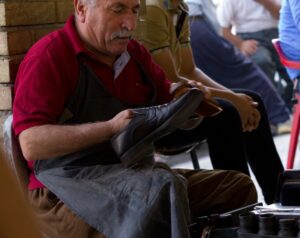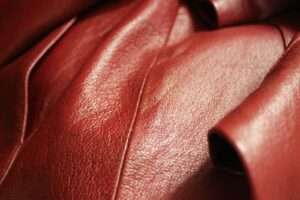
Every hide that arrives at the NABOLY factory in Hebron is different. Natural leather carries the marks of the animal it came from — scars, growth lines, insect bites, variations in grain and thickness — and no two hides stretch the same way. That is why, three generations in, we still cut leather by hand before anything goes to the clicking press.
What “cutting by hand” actually means
It does not mean a knife and a steady nerve. It means a cutter lays the full hide out on the bench, reads it, and decides where each pattern piece will sit before any blade or press die touches it. The press does the cutting; the judgement about where to cut is the part that has never been automated here.
A standard men’s shoe upper is six to ten separate pieces. On a hide roughly 4.5 square meters in size, the cutter is solving a puzzle with constraints that change with every skin.
Reading the hide
Leather is not uniform. The back and shoulder are tight and firm; the belly and flanks are looser and stretch more. A skilled cutter can see — and feel — where a hide will flex and where it will hold its shape.
- Vamps and toe pieces take the most bending in wear, so they come from the tighter back and shoulder.
- Quarters and straps can carry a little more give, so they come from areas with more stretch.
- Direction matters. Pieces are oriented so the leather’s natural stretch runs across the foot, not along it — a strap cut the wrong way round will gape within a month.
- Scars and brand marks are worked around, or placed where they will sit under a buckle or inside a quarter.
Get this right and waste goes down and the shoe lasts longer. Get it wrong and the pair looks fine on the shelf and fails in the first season.
Why not fully automate?
We are not romantic about hand work. We use modern machinery wherever it gives a better result than hands alone: lasting, stitching, sole attachment and finishing are all machine operations in our factory, and they are more consistent than any person could be across a production run.
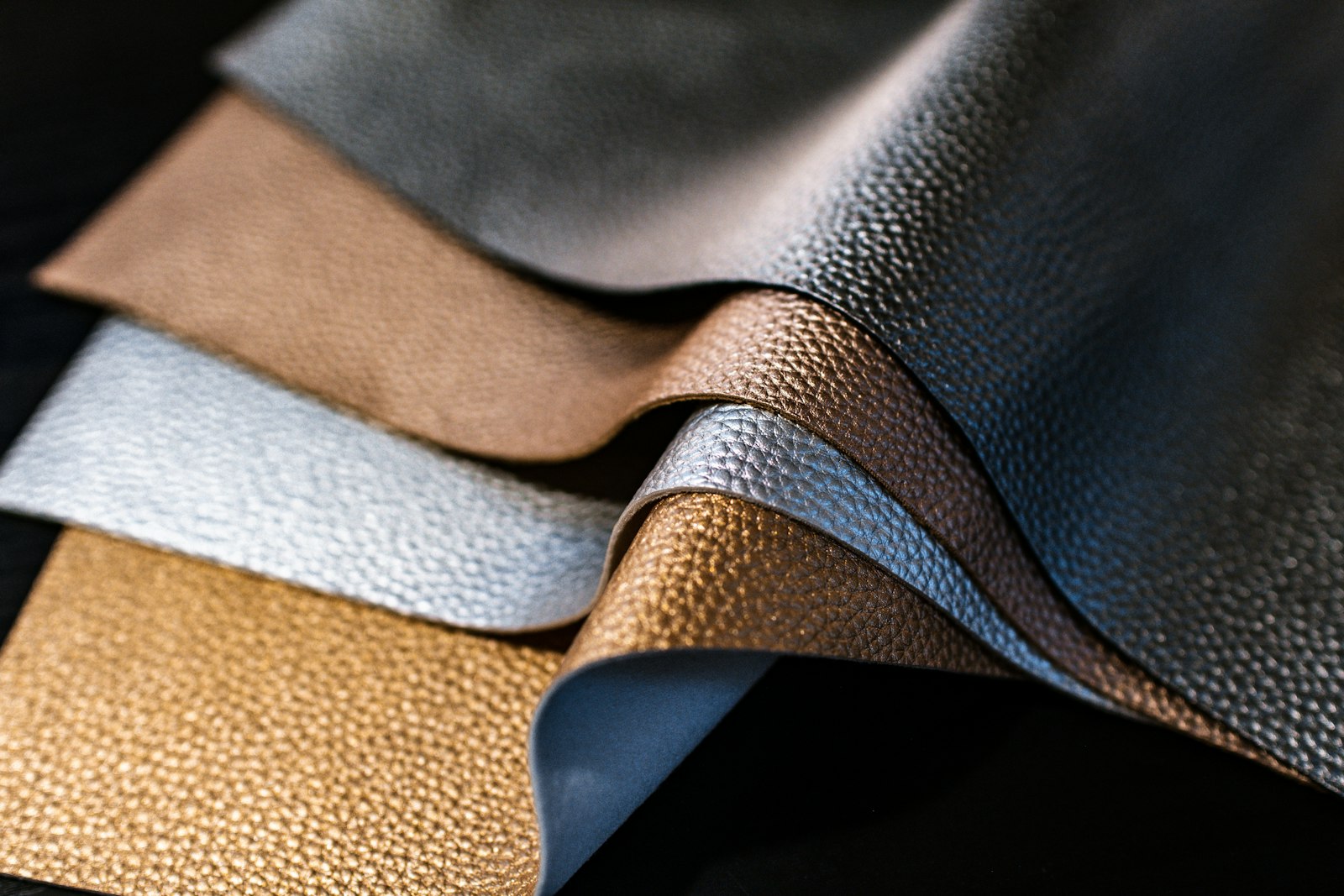
Cutting is the one stage where judgement still beats speed. Automated nesting software optimizes for yield on a rectangle of uniform material. A hide is not a rectangle and is not uniform. The software cannot see that a particular patch will stretch, or that a growth line running through a vamp will show as a crease after fifty wears.
The extra minutes per hide are the difference between a strap that softens with wear and one that cracks.
What it means for the pair you end up wearing
Three practical things follow from cutting this way:
- Straps ease, they do not stretch out of shape. Because the stretch direction is controlled at the cutting bench, a NABOLY strap gives a few millimeters in the first weeks and then holds. That is why our sizing guide tells you to size down on strap sandals and take your usual size on closed-back models.
- No two pairs are identical. Grain, tone and small natural markings vary between pairs and even between the left and right of the same pair. This is a characteristic of natural leather, not a defect — see our returns policy for where the line falls.
- Repairs are possible. A pair cut with the grain respected can be resoled and the uppers survive it.
See it for yourself
Our gallery shows the cutting floor, and the manufacturing page walks through the full process from hide to boxed pair. Wholesale customers are always welcome to visit the factory in Ein Arab, Hebron — and if you are ordering for a shop, the wholesale guide covers minimums, lead times and shipping.