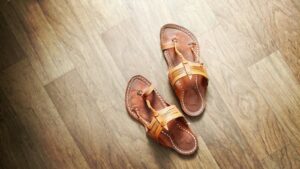
NABOLY sandals are made on our own lasts in EU sizes 20 to 46, depending on the model. Most customers take their usual EU size and it is right first time. This sandal sizing guide covers the handful of cases where it is worth thinking twice before you order.
Start with the foot, not the shoe
The most reliable way to size any sandal is to measure the foot rather than compare it with a shoe you already own. Stand on a sheet of paper with your heel against a wall, mark the tip of the longest toe — which is not always the big toe — and measure from the wall to the mark in centimeters. Do it late in the day, when feet are at their largest, and measure both feet: a difference of 3–5 mm between them is completely normal. Size to the larger foot.
As a rough guide, EU size is roughly the foot length in centimeters multiplied by 1.5, plus a little room. A 26 cm foot lands around EU 41. Use that as a starting point, then apply the model rules below.
Straps stretch a little, soles do not
Leather straps ease by a few millimeters over the first weeks of wear as they warm up and mold to the foot. The footbed and sole do not change at all.
- Open strap sandals — if you are between sizes, take the smaller one. The straps will give; the footbed will not.
- Closed-back and buckle models (for example Model 104 and Model 104‑2) — take your usual size. The ankle strap already adjusts, so there is nothing to gain from sizing down.
- Fisherman and closed-toe models — take your usual size, and go up one if you have a high instep or intend to wear socks.
- Slides and mules — take your usual size. The foot should sit fully on the footbed with no overhang at the heel.
Width and instep
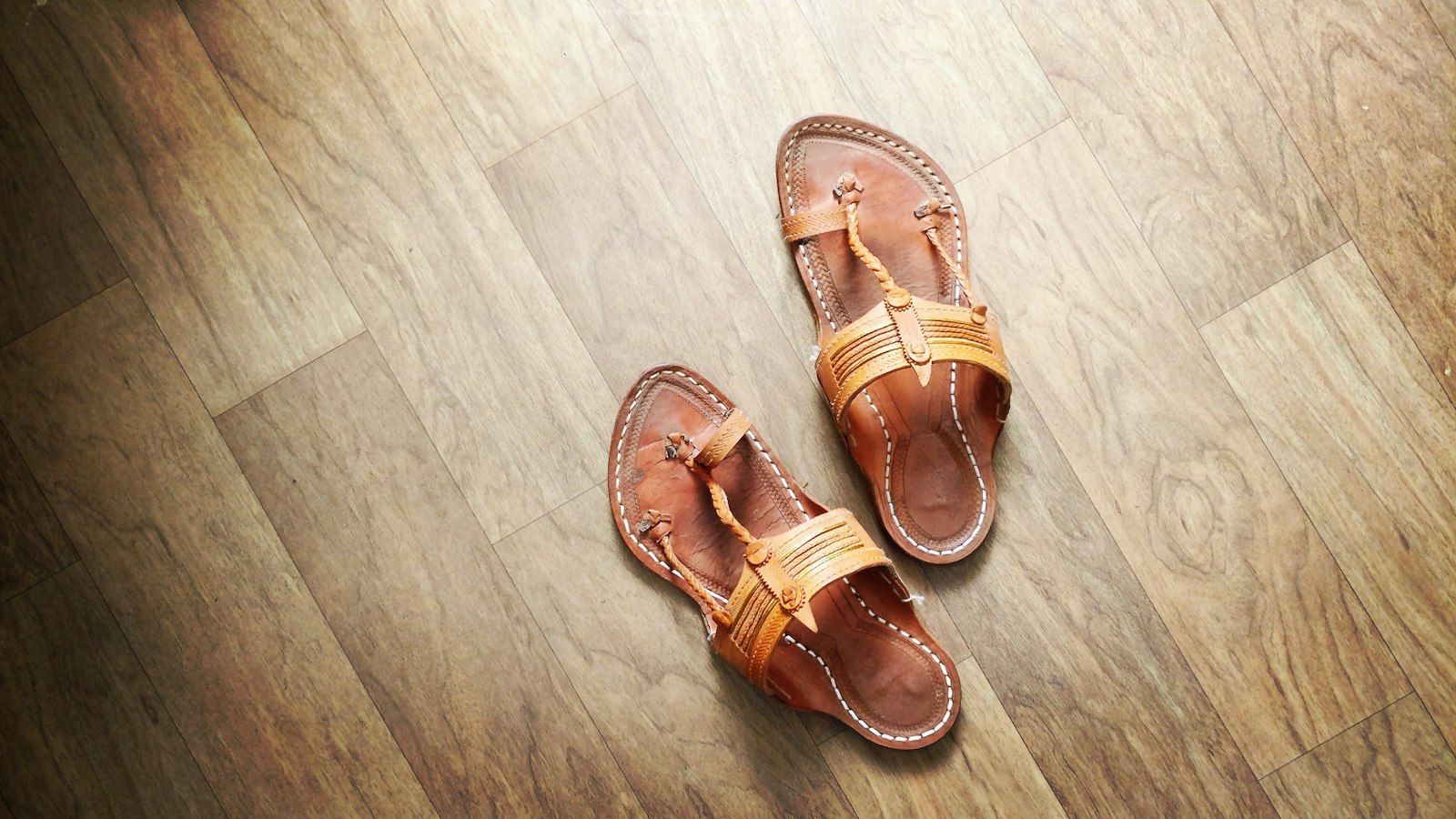
We build on a medium-width last. If you normally need a wide fitting, the open strap models suit you better than the closed ones, because the buckle gives you real adjustment across the widest part of the foot rather than a fixed opening. A high instep is the other common issue — on a three-strap model, the middle strap is the one that matters, and sizing up by one rarely helps because it lengthens the footbed without opening the instep.
Kids’ sizes
Kids’ models run from EU 20 to 35. Leave roughly a thumb’s width — about 1 cm — between the longest toe and the front edge of the footbed to allow for growth. Do not go further than that: a sandal that is too long makes the child grip with their toes to keep it on, which wears the footbed unevenly and is uncomfortable. Check the fit every three months during a growth spurt.
How to tell the fit is right
Try the sandals indoors, on a clean surface, before wearing them outside — a sole that has been worn outdoors cannot be returned, as our returns policy explains. Then check:
- The foot sits fully on the footbed, with no toe or heel overhang.
- You can slide one finger comfortably under each strap.
- The widest part of your foot sits at the widest part of the footbed.
- Nothing presses on the instep when you walk.
Still unsure?
Send us the length of the foot in centimeters and the model number on WhatsApp or by email and we will confirm the size before you order. Browse the full range in the catalog, or read how the leather is prepared in why we still cut leather by hand.