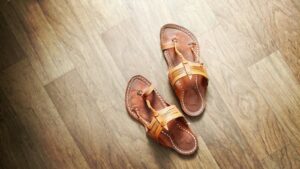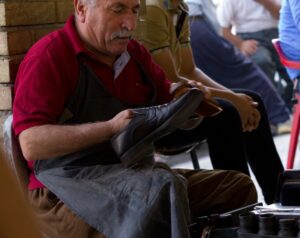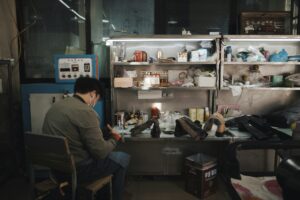
Walk into any shoe shop and half the stock will say genuine leather somewhere on the box. It is one of the least useful phrases in footwear. It tells you the material came from an animal hide. It tells you nothing about whether the pair will still be wearable next summer.
After three generations of cutting hides in Hebron, here is what we actually look at — and what you can check yourself, in a shop, in under a minute.
Start with the cut edge
This is the fastest test there is. Find an exposed edge — inside the strap, around a buckle, along the tongue — and look at it closely.
- Full-grain or top-grain leather shows a dense, slightly fibrous cross-section, the same color most of the way through, with fibers that get looser toward the flesh side.
- Bonded or coated material shows a flat, even layer sitting on a fabric or pulp backing. You can often see the join as a line.
If the edge looks like a sandwich, it is a sandwich.
Look at the grain, then look again
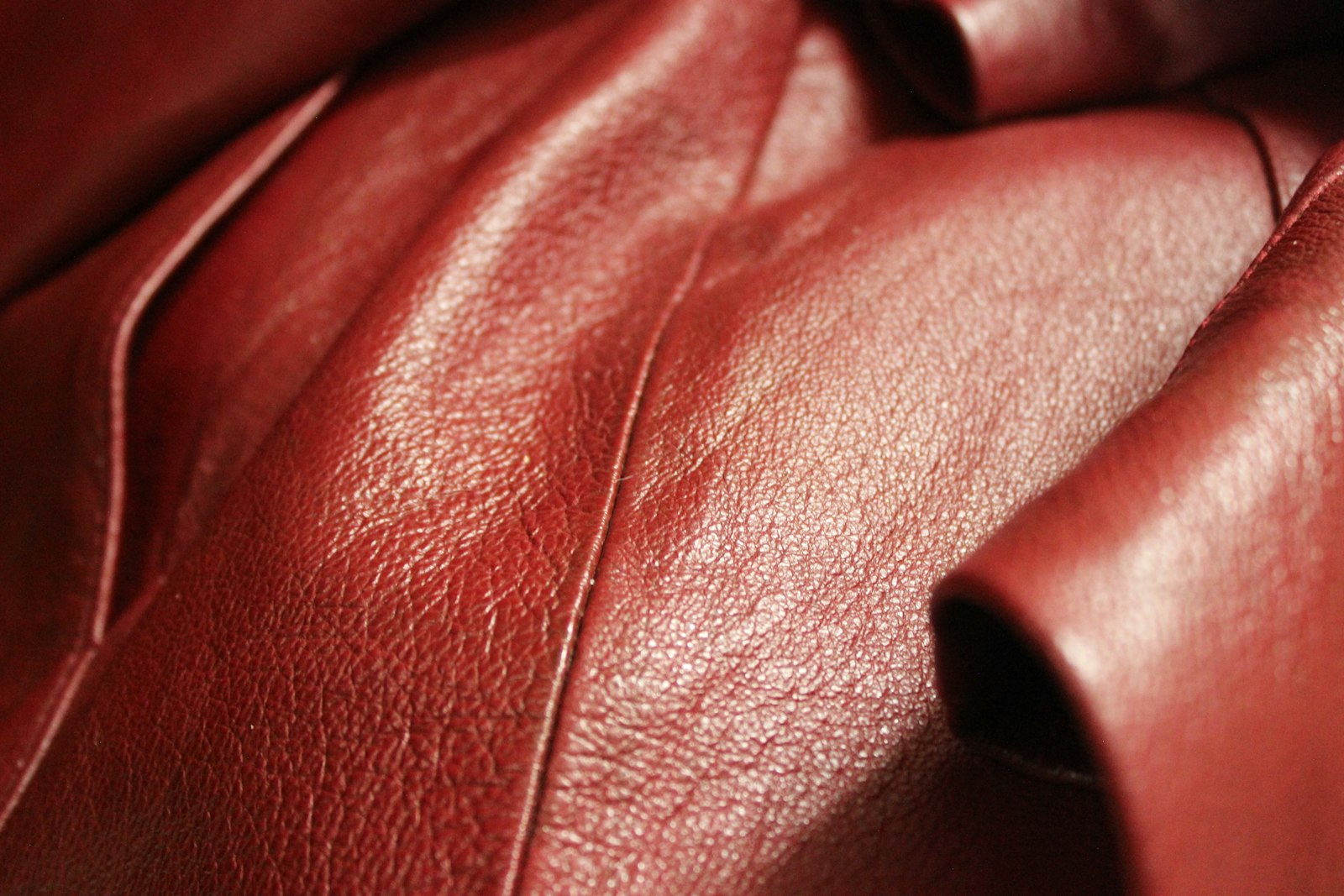
Real leather is a record of the animal it came from. Pores vary in size and spacing. There are growth lines, the odd healed scratch, a change in tone across a panel. It is irregular in an unrepeatable way.
Printed grain repeats. Not obviously, but it repeats — the same cluster of pores turns up again a few centimeters along. Once you have seen it, you cannot unsee it.
Press it with your thumb
Push a thumb into the vamp of a closed shoe, or the widest part of a sandal strap. Good leather creases into fine lines and then relaxes back. Coated material either does not move at all, or it wrinkles into one hard crease that stays.
The smell test still works
Tanned hide smells of tannin and oil — warm, slightly sweet, faintly animal. Coated and bonded materials smell of solvent or of nothing. It is not a laboratory test, but it is a very hard thing to fake.
Check the lining, not just the outside
This is where corners get cut most often, because customers rarely look. A leather upper over a synthetic lining will trap heat and moisture against the foot — which is exactly what makes a closed shoe unwearable in July.
At NABOLY we line with leather because the inside of the shoe is the part your foot actually touches. The manufacturing page shows where the lining sits in the build.
Weight and flex tell you about the sole
Pick the shoe up. A leather upper on a properly built sole has a reassuring heft to it; very light often means thin material and a hollow sole unit. Then hold the toe and heel and bend. It should flex across the ball of the foot and resist through the arch. A shoe that folds in half has no shank, and your arch will be doing that work instead.
What the labels actually mean
- Full-grain — the whole top surface of the hide, nothing sanded away. The strongest and the most honest.
- Top-grain — the surface lightly corrected. Still real leather, slightly more uniform.
- Genuine leather — a legal description, not a quality grade. Usually a lower split.
- Bonded leather — leather dust and offcuts glued onto a backing. Treat it as a synthetic.
What to expect from a good pair
Real leather will not look identical pair to pair, and the left will not match the right exactly. Tone varies, grain varies, small natural marks come with the territory. That is a characteristic of the material, not a fault — our returns and refunds page says where we draw that line.
What a good pair will do is break in rather than break down, take a polish, hold its shape and come back from a resole. If you are choosing a size, the EU sizing guide covers how NABOLY sandals and closed shoes differ.
See it on the bench
Everything above is easier to understand with a hide in front of you. Our gallery shows the cutting floor in Ein Arab, and why we still read every hide by hand explains what the cutter is looking for. If you are buying for a shop, the wholesale page is the place to start.