Written by the NABOLY Team | Hebron, Palestine | Updated October 21, 2026 | Approximately 12-minute read
In Hebron, Palestine, shoemaking is more than a manufacturing activity. It is a tradition passed through families, practiced in workshops, developed into factories, and carried forward by generations of people who understand the materials and skills involved in producing leather footwear.
For decades, Hebron has been recognized as the center of Palestinian shoe manufacturing. Its reputation was built through leatherworking knowledge, skilled craftsmen, family-operated businesses, and an interconnected network of workshops and suppliers.
The city’s shoemaking industry has produced everything from everyday leather sandals and traditional footwear to dress shoes, casual shoes, and specialized boots.
While the industry has experienced economic challenges and technological changes, its heritage remains an important part of Palestinian manufacturing identity.
Why is Hebron known as Palestine’s shoe capital? Hebron earned this reputation because of its historical concentration of footwear factories, leather tanneries, skilled shoemakers, and related manufacturers. The city developed an interconnected footwear industry in which generations of craftspeople contributed to the production of leather shoes and sandals for domestic and international markets.
Among the companies connected to this history is NABOLY, a family-rooted leather footwear manufacturer whose published company history traces its beginnings to the 1940s.
To understand NABOLY’s background, it helps to understand how Hebron became one of Palestine’s most important centers of footwear production.
Why Is Hebron Famous for Shoemaking?
Hebron, known in Arabic as Al-Khalil, is one of Palestine’s major commercial and industrial cities.
Although it is widely associated with traditional glassmaking, pottery, and other forms of craftsmanship, leatherworking and shoemaking have also played a significant role in the city’s industrial development.
What distinguishes Hebron’s footwear industry is not simply the presence of individual shoe factories.
It is the concentration of different businesses involved in creating a finished product.
The local footwear industry historically included leather tanneries, shoe designers, material suppliers, pattern makers, sole manufacturers, specialized workshops, footwear factories, and retailers.
Together, these businesses created a manufacturing network capable of supporting multiple stages of shoe production.
The Hebron Leather & Shoes Cluster, an industry initiative supported by the Hebron Chamber of Commerce and Industry, describes the city’s footwear knowledge as a craft developed and transferred across generations.
This connection between family businesses, specialized workers, and local suppliers helps explain why shoemaking became closely associated with Hebron.
Hebron’s Footwear Heritage at a Glance
| Historical Milestone | Significance |
|---|---|
| Traditional family workshops | Shoemaking skills developed and passed between generations |
| 1940s | NABOLY traces its family manufacturing roots to this period |
| 1970s–early 1990s | A major period of employment and footwear production in Hebron |
| 1989 | NABOLY’s published history identifies the establishment of its branded footwear line |
| 1995 | NABOLY’s company timeline records the beginning of its export journey |
| 2013 | The Hebron Leather & Shoes Cluster was established |
| 2025 | UNIDO and Palestinian partners announced a sustainable footwear industry development initiative |
These milestones illustrate how the city evolved from traditional workshops into a more specialized manufacturing center while maintaining connections to its earlier craftsmanship.
The Origins of Hebron’s Leather and Footwear Traditions
Long before modern footwear manufacturing machinery became common, shoemaking depended heavily on manual skills.
Craftspeople needed to understand the properties of leather, select suitable materials, create footwear patterns, and assemble components that could withstand everyday use.
Different tasks required different kinds of knowledge.
A person preparing leather needed to understand the material’s thickness, flexibility, and surface condition.
A worker cutting leather for shoe uppers needed to position patterns accurately while accounting for material variation.
A shoemaker assembling the finished product needed to understand fit, shape, stitching, and sole attachment.
In traditional manufacturing communities, these skills could be developed through practical experience.
Learning Shoemaking Through Family Workshops
Family-operated workshops played an important role in the development of Hebron’s footwear industry.
Knowledge could pass from an experienced shoemaker to a younger family member or apprentice working alongside them.
Training often involved observing practical tasks, learning how tools were used, and understanding the relationship between materials and finished footwear.
As experience developed, workers could take on more complicated production responsibilities.
This created an important connection between generations.
The craft was not limited to written instructions. It also included practical judgment developed over time.
Even as mechanized equipment became more widely available, knowledge of footwear construction continued to matter.
The Connection Between Leatherworking and Shoemaking
Hebron’s footwear history is closely connected to leather production.
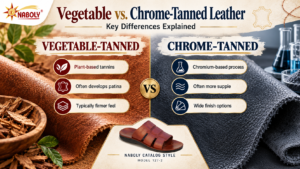
Leather tanning transforms animal hides into a material that can be used for footwear and other products.
The tanning process, leather thickness, finishing methods, and material characteristics all influence how leather behaves during manufacturing.
Historically, the proximity of tanneries and shoe workshops helped support Hebron’s leather-based industries.
However, not all leather used by Hebron’s footwear manufacturers has necessarily originated locally. Material sourcing has changed over time, and manufacturers may use different domestic or imported materials depending on availability and production requirements.
The important historical connection is that leather processing and footwear manufacturing developed as related industries within the city.
How Traditional Leather Shoes Were Made in Hebron
The process of manufacturing leather footwear involves multiple stages, regardless of whether the production takes place in a small workshop or a larger factory.
Traditional skills remain relevant because leather is a natural material whose properties can vary.
1. Selecting Suitable Leather
Footwear production begins with choosing materials appropriate for the intended design.
Leather selection can involve examining thickness, flexibility, surface finish, and visible material characteristics.
For example, a leather sandal upper may require different material properties from a structured boot.
Careful material selection helps manufacturers match a shoe’s construction to its intended use.
2. Designing the Footwear
Before cutting begins, the manufacturer needs a design that identifies the shape and components of the shoe.
A footwear design may include specifications for the upper, lining, insole, outsole, heel, and any straps or fastenings.
The design must also account for the shoe’s intended size range and fit.
In traditional workshops, pattern development relied heavily on practical experience.
Modern footwear manufacturers can also use computer-aided design and specialized pattern-making equipment.
3. Cutting the Leather
The leather is cut into individual components according to the footwear pattern.
Accurate cutting matters because irregular pieces can affect assembly and appearance.
Material orientation and variations within the hide may also influence cutting decisions.
This is one of the stages where material knowledge and manufacturing precision work together.
4. Preparing and Stitching the Upper
The upper is the part of the shoe that covers or holds the foot.
Depending on the design, it may contain several leather pieces joined through stitching or other construction methods.
A leather sandal may use straps and shaped upper components, while a closed-toe dress shoe typically requires a more extensive upper.
Consistent stitching and properly assembled components contribute to the footwear’s finished appearance.
5. Lasting and Shaping
Many closed-toe shoes are shaped around a form called a shoe last.
The last helps establish the intended dimensions and shape of the finished footwear.
This stage is especially important for achieving the correct relationship between the upper, toe box, heel, and other components.
Different shoe styles may require different last shapes.
6. Attaching the Sole
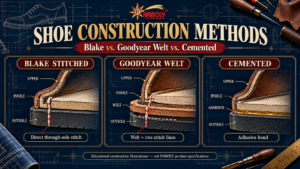
The outsole can be attached using different manufacturing methods.
Depending on the product, these may include adhesives, stitching, direct injection, or combinations of techniques.
No single construction method is automatically best for every type of footwear.
The correct approach depends on the materials, product specifications, intended use, and manufacturing requirements.
7. Finishing and Inspection
Before footwear is prepared for sale, manufacturers may inspect the appearance and assembly of the finished product.
Inspection can include checking stitching, materials, sole attachment, sizing, symmetry, and surface finishing.
The specific checks vary by product type and manufacturer.
The overall process demonstrates why shoemaking requires expertise beyond simply cutting and assembling leather.
Hebron’s Golden Age of Shoe Manufacturing
The importance of footwear production in Hebron becomes especially clear when examining the industry’s expansion during the late twentieth century.
From approximately the 1970s through the early 1990s, shoe manufacturing was a major source of local employment.
Workshops and factories produced footwear for different customers and supported other businesses that supplied materials, components, and services.
According to a 2015 account published by Al Jazeera, an industry representative recalled a period when Hebron’s footwear sector supported more than 1,000 workshops and approximately 35,000 workers.
These figures describe historical industry estimates rather than current employment levels.
Nevertheless, they illustrate the significant role footwear production once played in the city’s economy.
An Industry That Extended Beyond Shoe Factories
The economic importance of footwear manufacturing was not confined to workers assembling shoes.
A growing footwear sector could also support demand for:
- Leather tanning and finishing
- Footwear patterns and design
- Shoe soles and heels
- Industrial machinery
- Packaging materials
- Transportation and distribution
- Retail footwear businesses
- Equipment maintenance and specialized services
This network made footwear production part of a broader local industrial economy.
Why Family Businesses Were Important
Many workshops were family-owned or family-operated.
Family involvement allowed businesses to maintain practical manufacturing knowledge while adapting to new products and changing customer preferences.
Some remained specialized workshops, while others gradually adopted machinery, expanded their product ranges, or developed branded collections.
This mixture of traditional skills and industrial development became an important characteristic of Hebron’s shoemaking heritage.
The Evolution From Handmade Footwear to Modern Factories
The history of Hebron’s shoe industry is not simply the story of handmade footwear being replaced by machines.
It is also the story of craftspeople learning to use new production methods while retaining the skills required to work with leather.
As manufacturing technology developed, footwear producers gained access to machinery for cutting, stitching, shaping, sole attachment, and finishing.
These technologies made it possible to improve consistency and support different production volumes.
Yet machinery alone does not guarantee a well-manufactured shoe.
Footwear still requires appropriate materials, accurate design, fit evaluation, and attention to construction.
What Changed With Modern Shoe Manufacturing?
| Traditional Workshop Practices | Modern Manufacturing Capabilities |
|---|---|
| Patterns prepared manually | Digital pattern and design tools may be used |
| Leather cutting with hand tools | Manual and machine-assisted cutting |
| Sewing with workshop equipment | Specialized footwear stitching machinery |
| Manual shaping and assembly | Machine-assisted lasting and assembly |
| Traditional sole attachment | Adhesive, stitched, and molded sole systems |
| Visual workmanship inspection | Documented inspections and testing methods |
Modern footwear manufacturing may combine methods from both columns.
A manufacturer can use industrial equipment while still depending on experienced workers to assess materials, operate machinery, inspect products, and resolve production problems.
This balance between craftsmanship and technology is particularly relevant to Hebron’s manufacturing identity.
NABOLY’s Place in Hebron’s Shoemaking History
NABOLY’s history provides an example of how a family footwear business can evolve across generations.
The company’s published history identifies Salman al-Natshe as its founder and traces the roots of the business to the 1940s.
According to NABOLY’s account, Salman developed footwear experience in the Levant before continuing his work in Hebron.
The business gradually developed from its early shoemaking activities into a manufacturer offering different footwear collections.
Over time, family members continued developing the operation and adopting new manufacturing techniques.
The Early Family Manufacturing Tradition
NABOLY’s background is connected to the practical skills of shoe production.
Its company history describes a business built around footwear manufacturing, rather than a retail brand created independently of the production process.
That distinction is an important part of its identity.
The experience of making shoes requires understanding the relationship between materials, construction, fit, and the needs of the wearer.
As the business developed, these considerations continued to influence the types of footwear produced.
From a Family Workshop to Branded Footwear
NABOLY’s published timeline identifies 1989 as the year the NABOLY brand was established.
The history also describes the introduction of new product lines and manufacturing processes during different stages of the company’s development.
These changes reflected the broader evolution of footwear production, including the growing use of specialized machinery.
Rather than remaining limited to one footwear style, NABOLY expanded its product development over time.
The Introduction of Men’s Leather Sandals
According to the company’s published timeline, NABOLY introduced a men’s sandal production line in 1991.
Leather sandals have long been an important footwear category for manufacturers serving customers in warmer climates and markets where open footwear is widely worn.
However, producing sandals involves its own design and construction considerations.
The straps, sole, footbed, and overall shape must work together to support the foot comfortably.
The development of sandal collections represented one stage in NABOLY’s expansion beyond its earlier footwear offerings.
Expanding Beyond the Local Market
NABOLY’s published company history identifies 1995 as an important milestone in its international export development.
The company describes expanding beyond Palestine into other markets.
For a footwear manufacturer, international sales create additional considerations.
Different countries may use different footwear sizing systems, labeling conventions, and customer preferences.
Retailers may also require different styles, product information, or inventory assortments.
The development of export experience is therefore part of the broader story of how Palestinian footwear manufacturing has connected with customers beyond its domestic market.
A Broader Range of Footwear
NABOLY’s published company information describes the development of multiple footwear categories, including sandals, casual shoes, comfortable footwear, dress shoes, and work-related footwear.
The evolution of these collections reflects the importance of adapting manufacturing knowledge to different product requirements.
A casual sandal, for example, will not necessarily use the same construction, fit, or materials as a structured boot.
Each category presents distinct production considerations.
For NABOLY, this variety is part of its continuing identity as a footwear manufacturer based in Hebron.
Learn more about the company’s production background on our Shoe Manufacturing page.
Why Palestinian Leather Craftsmanship Remains Important
Palestinian shoemaking is significant for reasons that extend beyond the finished products.
It represents a connection between manufacturing knowledge, local economic activity, family enterprises, and regional traditions.
Understanding that connection helps explain why preserving production skills matters.
Passing Knowledge Between Generations
Some manufacturing knowledge can be recorded through instructions, technical drawings, or machinery settings.
Other knowledge develops through hands-on experience.
A skilled worker may recognize subtle differences in leather, understand how a material should behave during assembly, or identify construction issues through practical inspection.
Training younger workers helps preserve these abilities.
Supporting Specialized Local Industries
A footwear manufacturer is part of a larger supply chain.
Businesses producing leather, soles, components, packaging, or specialized services may all contribute to the industry.
Maintaining footwear production can therefore support expertise in several related trades.
Preserving Palestinian Manufacturing Identity
Products can communicate where they were designed or manufactured.
For Hebron’s footwear industry, the connection to Palestinian craftsmanship reflects generations of local production knowledge.
However, the term Palestinian-made should refer to actual production origin and must not be confused with claims that every material or component necessarily originated in Palestine.
Accurate origin information is particularly important for international buyers.
Combining Tradition With Innovation
Preserving craftsmanship does not require manufacturers to avoid modern technology.
Improvements in design, manufacturing equipment, material evaluation, and quality inspection can help traditional industries remain relevant.
The challenge is to retain valuable practical knowledge while developing the capabilities needed for changing markets.
Challenges Facing Hebron’s Footwear Industry
Although Hebron developed a substantial footwear manufacturing sector, its history also includes periods of difficult economic adjustment.
Industry reports and historical coverage describe several pressures that contributed to reduced production and the closure of workshops.
Competition From Lower-Priced Imports
Greater access to mass-produced imported footwear introduced significant price competition.
Locally manufactured footwear often had to compete with products produced through different cost structures and at larger scales.
For smaller manufacturers, matching the lowest available retail price could be difficult.
Changes in Customer Preferences
Footwear demand changes over time.
Customers may look for new designs, different materials, lighter products, or changing fashion trends.
Manufacturers that cannot adapt their collections may find it harder to maintain sales.
Trade and Supply Chain Difficulties
The Palestinian footwear sector has also faced transportation, material access, and export-related challenges.
Such difficulties can complicate production planning and relationships with buyers.
The effects vary depending on the time period, supplier relationships, market, and business circumstances.
The Need for Specialized Skills
Footwear manufacturing benefits from training in design, production methods, material evaluation, and quality management.
Maintaining and developing these skills becomes especially important as the industry changes.
Why These Challenges Matter
The historical strength of a manufacturing industry does not guarantee its future success.
Businesses need to combine experience with product development, reliable communication, appropriate quality processes, and responsiveness to market demand.
For Hebron, maintaining its footwear heritage involves both preserving existing skills and making it possible for manufacturers to develop new capabilities.
How Hebron’s Shoemaking Industry Is Working Toward the Future
Despite the challenges experienced by the local sector, footwear remains an area of industrial development activity in Hebron.
Industry organizations, educational institutions, manufacturers, and international development partners have supported initiatives intended to improve competitiveness and technical capabilities.
The Hebron Leather & Shoes Cluster
The Hebron Leather & Shoes Cluster was established in 2013 with an initial group of 18 participating businesses.
Its purpose includes supporting cooperation among companies working in different parts of the leather and footwear supply chain.
The network brings together businesses involved in manufacturing, materials, components, and related services.
This kind of collaboration can help smaller manufacturers share knowledge, identify common challenges, and develop opportunities that may be difficult to pursue independently.
Design, Testing and Skills Development
The Leather & Footwear Products Development Center in Hebron has described services involving design development, product testing, technical training, and industry information.
These capabilities are relevant to manufacturers working to improve product design and manufacturing knowledge.
For example, testing can help evaluate materials or finished footwear characteristics, while training can support the development of specialized production skills.
The Sustainable Shoe Village Initiative
In July 2025, the United Nations Industrial Development Organization (UNIDO) and Palestinian partners announced an initiative to support the development of a more sustainable footwear industry in Hebron.
The proposed Sustainable Shoe Village focuses on shared infrastructure, production technology, skills development, and lower-carbon industrial systems.
The initiative reflects continued interest in strengthening the local leather and footwear manufacturing sector.
It is an industrial development project, not evidence that every footwear factory in Hebron has adopted the same technologies or environmental practices.
The Next Generation of Shoemakers
The future of Hebron’s footwear industry will depend partly on whether manufacturing knowledge continues to reach new workers and business owners.
It will also depend on product development, effective supplier relationships, access to markets, and the ability to respond to customer needs.
The city’s history provides a foundation, but future opportunities require continued development.
What Makes Footwear Manufactured in Hebron Distinctive?
The main distinction is the city’s accumulated manufacturing experience and concentration of related trades.
Hebron has a history of producing multiple footwear categories through family workshops and larger manufacturers.
Its manufacturing background connects leatherworking knowledge with practical experience in shoe construction.
However, the geographic origin of a shoe does not automatically determine its quality.
Products should still be evaluated according to their actual materials, construction, fit, intended use, and manufacturer-specific quality information.
For buyers, the value of Hebron’s industrial history is that it provides context for the expertise and manufacturing tradition behind the local footwear industry.
What Should International Shoe Retailers Know About Hebron Manufacturers?
For American footwear stores and international distributors, Hebron’s manufacturing history may be a useful starting point when researching suppliers.
However, choosing a footwear manufacturer requires more than understanding the region’s traditions.
Retailers should evaluate the capabilities of the specific company they are considering.
Evaluate the Available Footwear Collections
Review the manufacturer’s product range.
Determine whether its existing styles match your customers’ needs.
For example, a retailer specializing in leather sandals may require different footwear selections from a store focusing on business dress shoes or work boots.
Ask About Materials
Confirm the materials used in the upper, lining, footbed, and outsole.
Descriptions such as genuine leather should be supported with more specific information when necessary.
Verify International Sizing
Footwear manufacturers may use European size labels, while American retailers require US sizing information.
Request product-specific size charts and clarify the manufacturer’s sizing conventions.
Understand the Manufacturing Process
Ask how the footwear is constructed and what quality considerations apply to the selected styles.
This may include questions about stitching, sole attachment, material selection, and inspection.
Discuss Wholesale Requirements Directly
Order quantities, production timelines, samples, shipping, and other commercial requirements should be confirmed directly with the manufacturer.
These details may differ between businesses and product categories.
A manufacturer’s regional heritage can help explain its background, but a sound wholesale decision depends on specific and verifiable information.
A Short Timeline of NABOLY’s Footwear Development
NABOLY’s published company history identifies several developments that illustrate the evolution of a family footwear manufacturer in Hebron.
| Period | Development |
|---|---|
| 1940s | Company history traces its early roots to founder Salman al-Natshe |
| 1989 | Establishment of the NABOLY branded footwear line |
| 1991 | Introduction of a men’s sandal production line |
| 1995 | Expansion into international exporting |
| 2000s | Continued development of machinery, production methods, and footwear designs |
| 2013 | Company timeline identifies the addition of a men’s dress shoe design |
| 2017 | Development of a work footwear line |
This timeline summarizes NABOLY’s published company history. Earlier dates are described broadly because different company materials provide inconsistent founding and machinery milestones.
The broader significance of this timeline is the gradual transition from family shoemaking roots into a company offering several footwear categories.
The story illustrates how footwear manufacturers can retain an established identity while introducing new designs and production methods.
Frequently Asked Questions About Hebron’s Shoemaking Heritage
Why is Hebron called Palestine’s shoe capital?
Hebron is commonly described as the center of Palestinian shoemaking because of its historical concentration of shoe factories, leather workshops, tanneries, skilled workers, and specialized suppliers. The city’s industry developed over generations and became an important part of the local economy.
Is Hebron known for leather manufacturing?
Yes. Hebron has an established history of leatherworking, tanning, and footwear manufacturing. The city’s leather and footwear industries are closely connected, although material sourcing and manufacturing methods vary between businesses.
Are Palestinian leather shoes handmade?
Some Palestinian footwear includes substantial manual craftsmanship, while other products are made using modern industrial machinery. Many manufacturing processes combine skilled manual work with specialized equipment. The construction of a particular shoe depends on its manufacturer and design.
What kinds of shoes are manufactured in Hebron?
Hebron’s footwear industry has produced leather sandals, casual shoes, dress shoes, boots, children’s footwear, and specialized footwear. Available collections vary between manufacturers.
How old is Hebron’s shoe industry?
Hebron has a long tradition of shoemaking that developed through generations of family workshops. The industry expanded significantly during the twentieth century, particularly during the period from the 1970s through the early 1990s.
Why did Hebron’s footwear industry decline?
Historical industry reporting identifies several contributing factors, including competition from lower-priced imported footwear, trade and supply chain restrictions, and broader economic challenges. The effects have varied across businesses and time periods.
What is the Hebron Leather & Shoes Cluster?
It is an industry cooperation initiative established in 2013 to support businesses involved in Hebron’s leather and footwear value chain. Its activities involve collaboration and efforts to strengthen manufacturing capabilities and market access.
Are leather shoes still manufactured in Hebron?
Yes. Hebron remains home to footwear manufacturers and related businesses. The local industry includes producers working with different shoe categories and manufacturing methods.
When was NABOLY established?
NABOLY’s published materials trace its family shoemaking roots to the 1940s, although the company’s pages give different specific founding dates. Its published history identifies Salman al-Natshe as the founder and describes the development of the NABOLY brand across subsequent generations.
Does NABOLY manufacture leather sandals?
NABOLY’s published history identifies leather sandals as an important part of its footwear development, with a men’s sandal line introduced in 1991. Buyers should contact the company for information about its currently available styles.
Can international retailers source footwear from Hebron?
International retailers can explore sourcing opportunities with footwear manufacturers based in Hebron. Available products, export arrangements, commercial terms, and order requirements should be confirmed with the specific manufacturer.
Why is preserving Palestinian shoemaking important?
Preserving shoemaking helps maintain specialized manufacturing knowledge, supports opportunities for future workers, and keeps an important part of Palestinian industrial heritage visible. Continued product development and training are also important to the industry’s future.
The Lasting Legacy of Hebron’s Shoemaking Industry
Hebron’s reputation as a center of Palestinian footwear production developed through the contributions of generations of workers, family workshops, specialized suppliers, and manufacturing businesses.
Its history is one of craftsmanship, industrial development, adaptation, and persistence.
Although machinery, materials, and customer preferences have changed, the knowledge required to manufacture footwear remains important.
Leather must still be selected for its intended purpose. Footwear must still be designed to fit. Components must still be assembled correctly. Finished products must still be evaluated for their intended use.
These principles connect the experience of traditional shoemakers with the work of modern manufacturers.
For businesses such as NABOLY, this history forms part of a wider manufacturing heritage that continues to shape the identity of Palestinian leather footwear.
Understanding the story behind Hebron’s shoe industry offers buyers, retailers, and interested readers a more complete perspective on the people and processes involved in producing leather shoes.
About NABOLY: Generations of Footwear Manufacturing in Hebron
NABOLY is a family-rooted Palestinian footwear manufacturer based in Hebron, with a company history extending back to the 1940s.
The business developed through generations of footwear manufacturing experience and expanded into different categories of leather shoes, sandals, and boots.
Its history reflects the larger evolution of Hebron’s footwear industry, from traditional production knowledge to the use of specialized manufacturing equipment and broader product collections.
Today, NABOLY continues to present its footwear manufacturing heritage as part of the company’s identity.
Explore more about our production background through our Shoe Manufacturing in Hebron, Palestine page.
Interested in Sourcing Leather Footwear From Hebron?
If you own a footwear store, independent boutique, or distribution business, NABOLY welcomes inquiries about its leather footwear collections.
Whether you’re researching Palestinian shoe manufacturers or exploring options for your next footwear collection, our team can review your product interests and discuss available wholesale opportunities.
Explore NABOLY Wholesale Leather Footwear
Written by the NABOLY Team — Preserving and developing a family footwear manufacturing tradition in Hebron, Palestine.