
Written by the NABOLY Team | Hebron, Palestine | Updated October 21, 2026 | Approximately 11-minute read
Finding the correct shoe size can become confusing when purchasing footwear from international manufacturers. A customer who wears a US size 9 may encounter European sizes such as 42 or 43, a UK size 8, or a completely different size designation when shopping abroad.
For footwear retailers, distributors, and international buyers, these differences become even more important when selecting inventory, importing shoes, or introducing a new footwear brand.
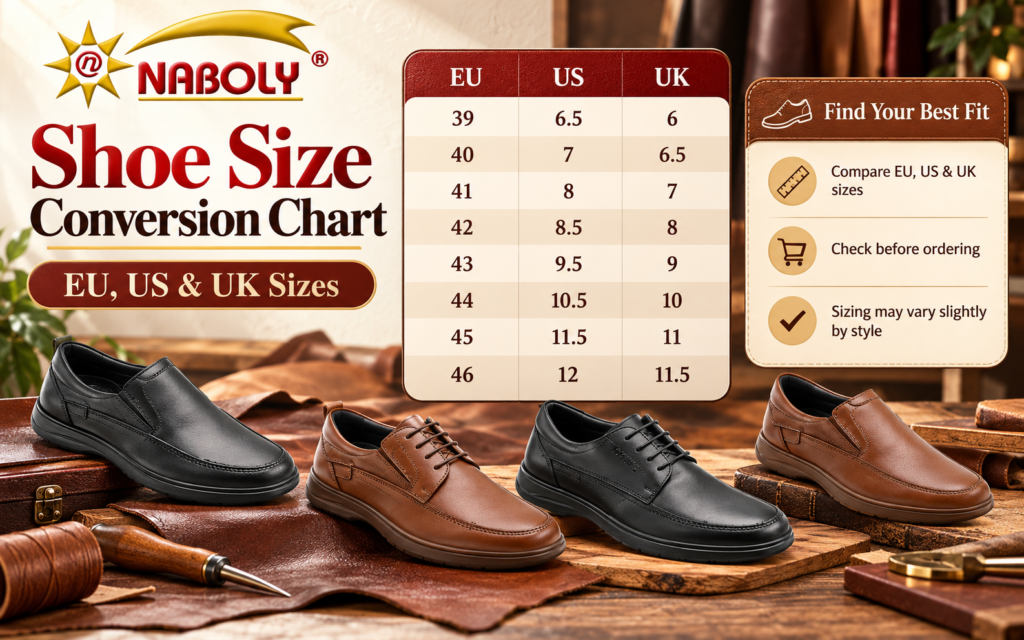
Shoe size conversion charts help translate between European (EU), United States (US), and United Kingdom (UK) sizing systems. However, conversions are approximate because shoe manufacturers may use different sizing methods, foot measurements, and footwear shapes.
In this guide, we explain how international shoe sizing works, provide comparison charts for men’s and women’s footwear, explain how sizes are commonly displayed in Middle Eastern markets, and demonstrate how to measure your feet accurately.
We also discuss the factors shoe retailers should consider when ordering leather sandals, loafers, dress shoes, casual footwear, and boots from international manufacturers.
International Shoe Size Conversion: Quick Answer
If you need to convert a shoe size between countries, the best starting point is to identify the original sizing system and compare it with an appropriate men’s or women’s conversion chart.
For example:
- A men’s US size 9 is approximately EU 42–43.
- A men’s US size 10 is approximately EU 43–44.
- A women’s US size 7 is approximately EU 37–38.
- A women’s US size 8 is approximately EU 39–40.
These comparisons are general estimates, not guaranteed equivalents.
US men’s and women’s size numbers are also different. A women’s US size 8 is not equivalent to a men’s US size 8.
For the most reliable fit, measure both feet in centimeters or millimeters and compare the larger measurement with the specific manufacturer’s shoe size chart.
Understanding the Different Shoe Sizing Systems
Before using a shoe size conversion chart, it helps to understand the systems used internationally.
European Shoe Sizes (EU)
European sizing is widely used throughout continental Europe and appears frequently in footwear sold internationally.
European shoe sizes commonly include numbers such as:
36, 37, 38, 39, 40, 41, 42, 43, 44, 45, and 46.
Some manufacturers also produce half or fractional European sizes.
The European system traditionally uses a unit known as the Paris point, equal to approximately 6.67 millimeters.
However, the way manufacturers translate this sizing system into actual footwear measurements can differ.
For this reason, a European size 42 from one manufacturer may not fit exactly like a size 42 from another.
United States Shoe Sizes (US)
The United States uses separate sizing scales for men’s, women’s, and children’s footwear.
For example, a women’s US size 8 and a men’s US size 8 represent different nominal sizes.
US sizes are also commonly offered in half-size increments.
When converting European sizes for the American market, manufacturers need to account for these differences rather than using a single universal conversion for every customer.
United Kingdom Shoe Sizes (UK)
The United Kingdom uses another numerical sizing system.
UK sizes often differ from US sizes even when the shoes are intended for similar foot lengths.
For example, a men’s US size 9 may correspond approximately to a UK size 8, depending on the manufacturer’s chart.
UK men’s and women’s sizes also require attention to the specific manufacturer’s labeling system.
Middle Eastern Shoe Sizes
There is no single universal shoe sizing system used across every Middle Eastern country.
Many footwear retailers and manufacturers in markets such as Palestine, Jordan, Saudi Arabia, and the United Arab Emirates use European size labels for at least some of their footwear collections.
However, international brands and retailers operating in these markets may display EU, US, or UK sizes depending on the product.
For example, a leather sandal labeled 42 in a Middle Eastern footwear store may use the European size 42 designation.
The important distinction is that “Middle East size 42” is not a separate standardized shoe size. Buyers should verify whether the label follows the European system or another manufacturer’s sizing convention.
Women’s Shoe Size Conversion Chart: EU to US and UK
The table below provides approximate international size comparisons for adult women’s footwear.
| EU Size | US Women’s (Approx.) | UK (Approx.) |
|---|---|---|
| 35 | 4.5–5 | 2.5–3 |
| 36 | 5–5.5 | 3–3.5 |
| 37 | 5.5–6.5 | 3.5–4.5 |
| 38 | 6.5–7 | 4.5–5 |
| 39 | 7.5–8 | 5.5–6 |
| 40 | 8–9 | 6–6.5 |
| 41 | 9–9.5 | 7–7.5 |
| 42 | 9.5–10.5 | 7.5–8 |
| 43 | 10.5–11 | 8.5–9 |
Important: These are approximate reference ranges compiled for general educational purposes. Different manufacturers may use different conversions, and these figures are not NABOLY’s verified product-specific sizing chart.
Example: What Is a Women’s US Size 8 in European Sizes?
A women’s US size 8 commonly falls around EU 39, although certain manufacturers may use a nearby European size.
When purchasing international footwear, the customer should compare the manufacturer’s chart with their measured foot length.
Example: What Is EU Size 38 in US Women’s Shoes?
EU size 38 is commonly near women’s US 6.5–7.
The exact equivalent depends on the manufacturer, and the correct choice may also depend on the shape and construction of the footwear.
Why Women’s Sizing Can Be Confusing
Women’s footwear includes many designs, from open leather sandals to structured closed-toe shoes.
Two shoes carrying the same labeled size may fit differently because of their:
- Toe shapes
- Heel constructions
- Upper materials
- Strap configurations
- Footbed designs
- Overall widths
A numerical conversion is useful, but it cannot replace checking the actual product’s fit specifications.
Men’s Shoe Size Conversion Chart: EU to US and UK
The following chart provides approximate international size comparisons for adult men’s footwear.
| EU Size | US Men’s (Approx.) | UK (Approx.) |
|---|---|---|
| 39 | 6.5–7 | 5.5–6 |
| 40 | 7–7.5 | 6–6.5 |
| 41 | 7.5–8 | 6.5–7 |
| 42 | 8.5–9 | 7.5–8 |
| 43 | 9–9.5 | 8–8.5 |
| 44 | 10–10.5 | 9–9.5 |
| 45 | 10.5–11 | 9.5–10 |
| 46 | 11.5–12 | 10.5–11 |
| 47 | 12–12.5 | 11–11.5 |
| 48 | 12.5–13.5 | 11.5–12.5 |
Important: These conversions are approximate. Always use the manufacturer’s product-specific sizing information when placing an order.
What Is a Men’s US Size 9 in European Sizes?
A men’s US size 9 is generally close to EU 42–43.
However, buyers should compare the specific manufacturer’s sizing guide because some footwear collections use different size mappings.
What Is EU Size 44 in US Men’s Shoes?
EU 44 often corresponds to approximately men’s US 10–10.5, depending on the manufacturer.
What Is a UK Size 9 in US Men’s Shoes?
A men’s UK size 9 is commonly around US size 10, although the exact relationship can vary.
When importing footwear for retail sale, it is better to confirm the original manufacturer’s labeled conversion than to rely exclusively on a general chart.
How to Measure Your Feet at Home: Step-by-Step
Measuring your foot length is one of the most useful steps you can take before converting shoe sizes.
You do not need specialized equipment to get a basic measurement.
What You Need
- Two sheets of paper
- A pencil or pen
- A ruler or measuring tape
- A hard, level floor
- A wall or straight edge
For the most useful results, measure your feet while standing and wearing the type of socks you would normally use with the footwear.
Step 1: Place Paper on a Hard Surface
Position a sheet of paper against a wall on a level, hard floor.
Avoid measuring on soft carpeting because an uneven surface can make accurate measurement more difficult.
Make sure the paper does not slide while you are standing.
Step 2: Stand With Your Heel Against the Wall
Place one foot on the paper with your heel gently touching the wall.
Stand naturally, keeping your weight balanced.
Measuring while standing is useful because the shape and length of your foot can change slightly under body weight.
Step 3: Mark Your Longest Toe
Have another person help you mark the point of your longest toe.
Keep the pencil upright rather than angled inward.
Your longest toe may not be your big toe, so make sure you identify the actual longest point.
Step 4: Measure From Heel to Toe
Step away from the paper and measure the distance from the wall-side edge of the paper to the mark.
Record the measurement in centimeters or millimeters.
For example:
Measured foot length: 26.4 cm = 264 mm
This number is your measured foot length. It is not automatically your shoe’s internal length or European size.
Step 5: Repeat With Your Other Foot
Measure your second foot using the same process.
Many people have slightly different measurements between their left and right feet.
Record both measurements.
Step 6: Use the Longer Measurement
If one foot measures 26.2 cm and the other measures 26.4 cm, begin your comparison with the longer measurement of 26.4 cm.
Then consult the manufacturer’s size chart.
Make sure the chart clearly states whether its measurements refer to foot length, insole length, internal shoe length, or another measurement.
Step 7: Check Foot Width
Length is only one part of shoe fit.
Measure the width across the broadest part of your forefoot if the manufacturer provides width measurements.
When selecting leather shoes, consider whether your feet are narrow, average, or wide.
Choosing a longer size does not always solve a width problem.
Shoe Size Measurement Example: What If Your Foot Is 26.5 cm Long?
Suppose you measure your feet and find:
| Measurement | Result |
|---|---|
| Left foot length | 26.2 cm |
| Right foot length | 26.5 cm |
| Measurement to use | 26.5 cm |
| Equivalent in millimeters | 265 mm |
Your next step is to find a manufacturer’s chart that identifies the recommended size for a 265 mm foot.
A general international chart may suggest a size in the neighborhood of EU 42–43 for men’s footwear, but that is only a starting point.
Do not assume that the shoe’s insole must be exactly 26.5 cm long or add an arbitrary amount to your measurement.
Different footwear designs require different allowances and use different measurement conventions.
The correct shoe size is the one that accommodates the measured foot appropriately according to the specific product’s sizing and fit guidelines.
Foot Length vs. Insole Length vs. Shoe Size: What’s the Difference?
These three measurements are often confused.
Foot Length
Foot length is the measurement from the back of the heel to the tip of the longest toe.
It describes the person’s foot, not the footwear.
Insole Length
Insole length refers to the physical length of an insole or footbed.
Depending on the design, an insole may not represent the full internal usable space of a shoe.
An open sandal footbed and a removable insole from a closed shoe should not automatically be evaluated using identical rules.
Shoe Size
Shoe size is the label assigned by a manufacturer according to its sizing system.
That number is associated with the intended fit of a product, but it is not necessarily a direct measurement of the shoe’s interior.
Why This Matters When Buying International Footwear
Imagine that a manufacturer advertises a size 42 leather shoe.
A retailer asks for the length in centimeters, and the manufacturer replies with a measurement.
Before comparing that number to a customer’s foot, the retailer should clarify exactly what the measurement represents.
Is it the intended foot length? The insole length? The internal shoe length? A manufacturing last measurement?
These values are not interchangeable.
Misunderstanding them can lead to inaccurate size conversions and avoidable customer complaints.
Do Leather Sandals Fit the Same as Closed-Toe Shoes?
Not necessarily.
Leather sandals and closed-toe shoes may use similar numerical sizing systems, but their physical fit can differ.
A sandal may have an open toe, adjustable straps, or an exposed footbed.
A loafer or dress shoe generally encloses more of the foot.
These differences affect how a customer experiences the fit.
How Leather Sandals Should Fit
When evaluating sandals, consider the following:
Toe position: The toes should remain comfortably supported without extending beyond the front edge of the sole.
Heel position: The heel should sit securely on the footbed without hanging over the back.
Strap placement: Straps should hold the foot comfortably without creating excessive pressure.
Width: The foot should fit appropriately within the edges of the sandal.
Footbed shape: Any molded arch or heel areas should align comfortably with the wearer’s foot.
A sandal that is technically long enough may still fit poorly if the straps are positioned incorrectly or the footbed is too narrow.
Can You Use Your Regular Shoe Size for Sandals?
Your usual size can serve as a starting point.
However, it is better to compare your measurements with the specific sandal’s sizing information.
Do not automatically size down because the sandal is open-toed.
Likewise, do not assume that every leather sandal will stretch enough to correct an initially uncomfortable fit.
Does Leather Stretch and Affect Shoe Size?
Leather can soften, flex, and change with use, but the amount depends on the material and the way the shoe is constructed.
Some leather uppers may accommodate small changes in fit over time.
However, this does not mean a customer should purchase footwear that is significantly too small.
The outsole, insole structure, stitching, and other components may limit how much the shoe can adapt.
A leather shoe should feel appropriately fitted when first tried on.
A break-in period should not be used as a substitute for selecting the correct size.
How Shoe Width Affects International Size Conversion
Two customers can have the same foot length and need different footwear widths.
For example, two people whose feet both measure 27 cm may not find the same size or shoe design equally comfortable.
One may have a relatively narrow foot, while the other has a wider forefoot.
This can be particularly noticeable with leather sandals, slip-ons, and structured dress shoes.
Common Footwear Width Terms
Some manufacturers use width labels such as:
- Narrow
- Standard or regular
- Wide
- Extra-wide
In certain markets, alphabetic width designations are also used.
However, width letters are not perfectly standardized across every manufacturer, country, and footwear category.
Why Retailers Should Pay Attention to Width
Retailers stocking footwear for different customer groups should consider whether a collection is designed around a narrow, regular, or wider fit.
When evaluating a new shoe supplier, ask whether the manufacturer provides width specifications or information about the footwear’s general fit.
This can be especially helpful when purchasing international footwear without the opportunity to try on every size before ordering.
Why the Same Shoe Size Fits Differently Between Manufacturers
A frequent customer question is:
“Why am I a size 42 in one shoe but a size 43 in another?”
The answer often involves differences in design and manufacturing.
1. Different Shoe Lasts
A shoe last is the three-dimensional form used during footwear manufacturing to create the intended shoe shape.
Different lasts can affect the fit of the toe box, instep, heel, and overall footwear volume.
Two shoes with the same labeled size may use different lasts.
2. Different Toe Shapes
A rounded-toe shoe, pointed dress shoe, and broad-toe sandal can feel very different even when their nominal lengths are similar.
The available space around the toes matters as much as the marked size.
3. Different Upper Materials
Leather thickness, flexibility, lining, and construction can influence how snug or relaxed a shoe feels.
4. Different Footbed Designs
Some shoes have contoured footbeds, while others have relatively flat constructions.
The relationship between the foot and the internal support structure can affect fit.
5. Different Manufacturing Conventions
Not all manufacturers interpret international size conversions identically.
This is why general EU-to-US conversion charts should be treated as references rather than universal guarantees.
What Should US Footwear Retailers Know About European and Middle Eastern Shoe Sizes?
For independent American shoe stores, purchasing directly from an overseas manufacturer can introduce additional sizing considerations.
A supplier may describe its products using European size numbers, while the retailer’s customers expect US men’s or women’s sizes.
The retailer must translate that information into useful, accurate product descriptions.
Confirm the Original Size System
Before ordering, ask which sizing system appears on the shoes and packaging.
For example, if the original manufacturer’s sizes are 40, 41, 42, 43, and 44, confirm that these are European sizes.
Do not assume based only on the factory’s country.
Request a Product-Specific Size Chart
A general international conversion chart can help retailers understand the approximate relationships between different systems.
However, a manufacturer’s own size chart is more useful for choosing an actual product.
Where available, request the intended foot-length range for each size.
Check Whether the Sizes Are Men’s, Women’s, or Unisex
US men’s and women’s sizing use different numbers.
Retailers should confirm whether a footwear collection is designed and labeled for men, women, or a unisex audience.
A single European size number should not be converted to one US size without considering the intended category.
Examine Samples When Available
Physical samples allow retailers to evaluate fit, construction, strap positioning, and footwear shape.
A size conversion chart cannot demonstrate how a particular shoe feels when worn.
Keep Sizing Information Consistent
Once the manufacturer confirms its size equivalents, retailers should use the same information consistently across:
- Online product descriptions
- Product labels
- Store displays
- Staff training materials
- Customer service responses
- Inventory management systems
Consistency helps reduce confusion and makes the shopping experience easier.
How to Plan Shoe Size Runs for Wholesale Orders
A size run refers to the distribution of different shoe sizes within a wholesale order.
For example, a retailer purchasing a leather sandal collection may need more pairs in some sizes and fewer in others.
The ideal distribution depends on the store’s actual customers.
Example of a Wholesale Size Run
Consider a hypothetical retailer planning an order of 100 pairs of one men’s footwear style:
| EU Size | Example Quantity |
|---|---|
| 40 | 10 |
| 41 | 15 |
| 42 | 25 |
| 43 | 25 |
| 44 | 15 |
| 45 | 10 |
| Total | 100 |
This example is for illustration only. It is not a recommended industry-wide distribution or a statement about NABOLY’s minimum orders.
A shoe store serving one market may need a different size mix from a store serving another.
For example, a retailer specializing in formal leather shoes may see different demand patterns from a store selling casual sandals.
How to Choose Your Size Distribution
Start with actual customer purchasing data whenever possible.
Review previous sales by size and product category.
Consider:
- Which sizes sell most frequently
- Whether customers request sizes that are often unavailable
- Differences between sandal and closed-shoe demand
- Seasonal purchasing patterns
- The store’s primary customer demographic
- Returns associated with sizing problems
If the store is introducing a new footwear brand, samples and an appropriately sized initial order can provide useful information for future purchasing decisions.
A Retailer’s International Shoe Sizing Checklist
Before confirming a wholesale footwear order, use this checklist to reduce sizing misunderstandings.
| Question | What to Confirm |
|---|---|
| Which sizing system is used? | EU, US, UK, or another designation |
| Is the collection designed for men or women? | Intended fit category |
| Are half sizes available? | Actual sizes produced |
| What does the size chart measure? | Foot length, insole length, or another specification |
| Are widths specified? | Narrow, regular, wide, or other options |
| Are physical samples available? | Availability and applicable sample terms |
| Does each style use the same sizing? | Style-specific differences |
| Can different sizes be combined in an order? | Available assortment and order requirements |
| How are sizes labeled on packaging? | Labels, cartons, and product identifiers |
| How are sizing concerns handled? | Applicable policies and agreed order terms |
Wholesale buying tip: Confirm product-specific size information before approving an order. A general international conversion chart should not be the only reference used to purchase large footwear quantities.
Common Shoe Size Conversion Mistakes
Mistake 1: Assuming Every EU 42 Equals the Same US Size
A European size 42 may be converted differently by different manufacturers.
Always verify the product’s size chart.
Mistake 2: Confusing Men’s and Women’s US Sizes
US men’s and women’s sizes are not identical.
Retailers should identify the intended category before converting numbers.
Mistake 3: Measuring Only One Foot
Feet can differ slightly in size.
Measuring both feet helps identify the longer measurement.
Mistake 4: Confusing Foot Length With Insole Length
The measurement of a foot is not necessarily the same as the length of a shoe’s insole or internal space.
Always verify what a manufacturer’s chart represents.
Mistake 5: Ignoring Foot Width
Selecting a longer shoe will not always solve a width-related fit problem.
Width, volume, and shape should be considered along with length.
Mistake 6: Assuming Middle Eastern Sizes Follow One Universal Chart
There is no single universal Middle Eastern shoe size system.
Although European labeling is common in many regional markets, different footwear brands may use different systems.
Mistake 7: Ordering Wholesale Inventory Without Confirming the Size Run
A retailer can select the correct footwear styles but still face inventory problems if the distribution of sizes does not match customer demand.
Confirm the available size range and use relevant sales data before ordering.
Frequently Asked Questions About International Shoe Sizes
What is EU size 42 in US shoes?
EU size 42 is approximately US men’s 8.5–9 or US women’s 9.5–10.5, depending on the manufacturer. Because conversions vary, check the product’s own size chart before purchasing.
What is EU size 40 in US shoes?
EU size 40 is approximately US men’s 7–7.5 or US women’s 8–9. Exact equivalents depend on the manufacturer and footwear design.
What is a US men’s size 10 in European sizes?
A men’s US size 10 is commonly around EU 43–44. The manufacturer’s published conversion chart should determine the final selection.
What is a US women’s size 8 in European sizes?
A women’s US size 8 generally corresponds to approximately EU 39–40, depending on the manufacturer.
Are shoe sizes in Palestine the same as European sizes?
European numerical sizes are commonly encountered in Palestinian footwear markets. However, buyers should confirm the original manufacturer’s labeling system because not every product uses the same sizing convention.
What shoe size system is used in Saudi Arabia and the UAE?
Footwear sold in Saudi Arabia and the UAE may display EU, US, or UK sizes depending on the retailer and manufacturer. European sizes are frequently encountered, but there is no single universal conversion for all footwear sold in these countries.
Is UK shoe sizing the same as US sizing?
No. UK and US shoe sizes use different numerical conventions. A men’s US size 9 may be close to UK size 8, but exact conversions depend on the manufacturer.
Does foot length in centimeters equal shoe size?
No. Foot length is a physical measurement, while shoe size is a label assigned through a sizing system. A manufacturer may use foot length to recommend a size, but the number is not automatically identical to the foot’s length in centimeters.
Should I size up if I am between shoe sizes?
It depends on the footwear design and manufacturer’s instructions. Check the relevant size chart, foot width, and fit guidance rather than automatically choosing a larger or smaller size.
Do leather shoes stretch after wearing them?
Leather can soften and adapt somewhat during use, but the amount depends on the material and shoe construction. Shoes should fit appropriately from the beginning rather than relying on stretching to correct a significant sizing problem.
Do leather sandals and dress shoes use the same sizes?
They may use the same numerical sizing system, but the fit can differ because of toe shape, footbed design, straps, upper construction, and other characteristics.
What should wholesale shoe buyers ask manufacturers about sizing?
Buyers should request the size range, original sizing system, product-specific conversion information, intended foot-length measurements, width options, labeling conventions, and available sample information.
Final Thoughts: Accurate Shoe Sizing Starts With the Right Measurements
International shoe size conversion charts provide a useful starting point when comparing footwear produced for different markets.
However, choosing the correct shoe size requires more than converting one number into another.
Foot length, width, footwear construction, and manufacturer-specific specifications all influence how a shoe fits.
For individual customers, measuring both feet and consulting the product’s own sizing guide can help make international footwear purchases easier.
For retailers and distributors, accurate sizing is also an important part of inventory planning, product descriptions, and customer service.
By understanding the differences between EU, US, UK, and commonly used Middle Eastern shoe labels, buyers can make more informed purchasing decisions.
About NABOLY: Leather Footwear Manufacturing in Hebron, Palestine
NABOLY is a Palestinian footwear manufacturer with a family manufacturing history dating to 1948 in Hebron, Palestine.
The company’s footwear collections include leather sandals, loafers, slip-ons, casual shoes, dress shoes, and boots.
For retailers sourcing footwear internationally, accurate product specifications and sizing information are important considerations when evaluating a potential manufacturing partner.
Learn more about our company’s background and approach to footwear production on the NABOLY Shoe Manufacturing page.
Looking for a Leather Footwear Manufacturer for Your Store?
NABOLY welcomes inquiries from U.S. shoe stores, independent boutiques, footwear retailers, and distributors interested in sourcing leather footwear.
If you’re exploring wholesale opportunities, share your preferred footwear categories, estimated quantities, and business requirements with our team.
We can discuss available styles and the next steps for your wholesale inquiry.
Explore Wholesale Leather Footwear With NABOLY
Written by the NABOLY Team — Leather Footwear Manufacturing in Hebron, Palestine.