Written by the NABOLY Team | Hebron, Palestine | Approximately 11-minute read
Leather is one of the most widely used materials in footwear manufacturing, but not all leather is produced, finished, or constructed in the same way. Two pairs of shoes may both be described as genuine leather, yet differ significantly in appearance, flexibility, surface finish, and long-term performance.
For footwear retailers, distributors, and everyday customers, understanding these differences makes it easier to compare products, evaluate quality, and make informed purchasing decisions.
The most commonly discussed leather terms include full-grain leather, top-grain leather, genuine leather, corrected-grain leather, and split leather. Although these names are often presented as a simple quality ranking, they actually describe different characteristics of the material.
Some identify which part of the hide is used. Others describe how the leather’s surface has been treated. Understanding that distinction is especially important when evaluating leather shoes.
What Are the Main Types of Leather?
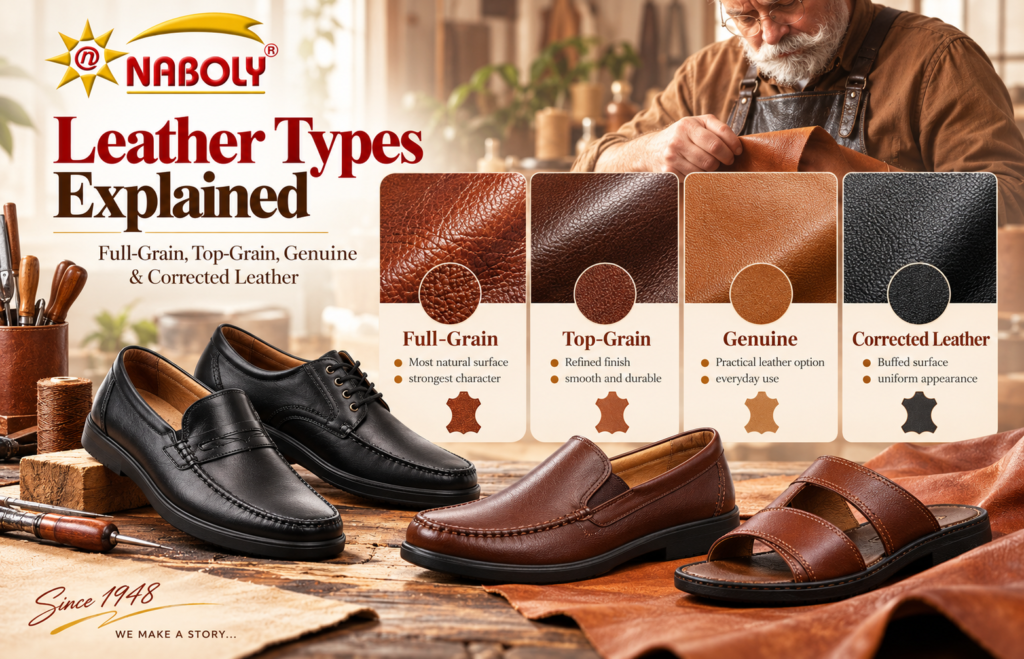
The short answer: Full-grain leather retains its original grain surface without corrective removal. Top-grain refers to the outer, grain-bearing portion of the hide, although the term is used differently in some commercial descriptions. Genuine leather identifies real leather but does not establish a specific quality grade. Corrected-grain leather has been buffed and finished to create a more consistent surface.
Here is a comparison of the most common terms:
| Leather Type | What It Means | Common Characteristics |
|---|---|---|
| Full-grain leather | Original grain surface remains intact | Natural texture and markings; appearance may evolve with wear |
| Top-grain leather | Generally refers to the grain-bearing upper portion of a hide | Can include full-grain or surface-corrected material depending on terminology |
| Genuine leather | Broad description indicating real leather | Does not identify the exact hide layer, finish, or quality |
| Corrected-grain leather | Grain surface is mechanically corrected and refinished | More uniform appearance and color |
| Split leather | Leather from a layer beneath the grain-bearing portion | Often used for suede or other finished applications |
Important: These descriptions are not a universal ranking from best to worst. Leather quality also depends on tanning, thickness, finishing, construction, and suitability for the intended product.
How Is Leather Made From an Animal Hide?
Understanding leather begins with the structure of the hide.
An animal hide contains multiple layers of fibrous material. During leather production, the hide is prepared, tanned, and finished to create a usable material.
Depending on the hide’s thickness and the manufacturer’s requirements, it may be split into different layers.
The Grain Layer
The grain is the original outer surface of the hide after the hair and epidermis have been removed.
This portion contains the naturally occurring surface texture associated with leather. It may include pores, variations in grain pattern, and other characteristics developed during the animal’s life.
The grain-bearing portion can be used with its original surface intact or mechanically treated to create a different finish.
The Lower Layers
Beneath the grain-bearing portion are fibrous layers that can also be processed into leather.
When separated from the grain-bearing layer, these are commonly called split leather.
Different treatments can create different textures, including suede-like surfaces or more heavily finished materials.
Why Hide Selection Matters
Even before leather is made into footwear, material selection affects what the manufacturer can produce.
Factors such as hide condition, thickness, fiber structure, visible imperfections, and intended use influence which material is appropriate.
For example, leather selected for a flexible sandal upper may need different characteristics from leather selected for a structured dress shoe.
This is why the name of a leather type alone cannot describe the complete quality of a finished shoe.
1. What Is Full-Grain Leather?
Full-grain leather is leather that retains its original grain surface without having that surface removed through corrective mechanical treatments such as buffing.
Because the natural grain remains intact, full-grain leather can preserve characteristics that make each hide visually distinctive.
Depending on tanning and finishing methods, these characteristics may include subtle variations in texture, natural markings, and differences in surface appearance.
Advantages of Full-Grain Leather
Natural appearance
Full-grain leather can display the original character of the hide, making it attractive for products where natural material variation is desirable.
Grain-surface integrity
The original grain structure remains intact rather than being partially removed through surface correction.
Potential for attractive aging
Certain full-grain leathers develop a patina over time, meaning their color, sheen, and overall appearance change through use and exposure.
However, not every full-grain finish develops the same patina.
Application versatility
Full-grain leather can be used in footwear, bags, belts, and other products depending on its thickness, softness, finish, and other properties.
Does Full-Grain Always Mean the Highest Quality?
Not necessarily.
Full-grain describes how the grain surface has been preserved. It does not automatically guarantee that the leather is properly tanned, free from structural weaknesses, appropriately finished, or suitable for every application.
A well-manufactured shoe made from carefully selected corrected-grain leather may perform better for a particular purpose than a poorly constructed shoe made from full-grain leather.
When evaluating footwear, the complete product matters.
When Might Full-Grain Leather Be Preferred?
Full-grain leather may appeal to customers looking for a natural appearance, material character, or a surface that changes attractively with wear.
Its suitability for sandals, loafers, dress shoes, or boots depends on the particular leather specification and finished construction.
2. What Is Top-Grain Leather?
Top-grain leather generally refers to leather from the upper, grain-bearing portion of the hide.
However, the term is not used consistently in every commercial setting.
Some technical references use top-grain and full-grain in closely related or equivalent ways. In other commercial descriptions, top-grain refers broadly to the upper layer, which may include leather whose grain surface has been corrected.
This is an important distinction for retailers.
A product advertised as top-grain leather does not necessarily tell you whether its original grain surface remains untouched.
Full-Grain vs. Top-Grain Leather
The main difference is what the label actually communicates.
- Full-grain: Specifically describes a grain surface that has not been mechanically corrected.
- Top-grain: Identifies the upper, grain-bearing leather but may not specify whether the surface has been corrected.
That means full-grain can be understood as a more specific description, while top-grain may require clarification.
Why Manufacturers Use Top-Grain Leather
The grain-bearing portion of a hide offers characteristics useful in footwear manufacturing.
Depending on the finishing process, manufacturers can create materials with different surface appearances, levels of softness, colors, and textures.
For retail buyers, the important question is not simply whether a product is top-grain.
Instead, ask:
Has the grain surface been preserved, lightly treated, or corrected through buffing and finishing?
The answer gives you more useful information than the marketing term alone.
3. What Does Genuine Leather Mean?
One of the most misunderstood phrases in footwear is genuine leather.
Many consumers assume genuine leather represents a particular grade or level of quality.
In reality, the term generally indicates that the material is real leather, rather than an entirely synthetic imitation.
It does not, by itself, explain which hide layer was used, how the surface was finished, or how the material will perform.
Is Genuine Leather Real Leather?
Yes. Genuine leather refers to real leather, but the phrase is not a complete material specification.
Products made from different leather constructions can be described as genuine leather.
For that reason, two genuine leather shoes can have very different characteristics.
One may feature a soft leather upper with minimal surface finishing. Another may use a material with a heavier protective coating.
The label alone cannot tell you which one is more appropriate for your needs.
Is Genuine Leather Lower Quality?
Not automatically.
The common internet claim that genuine leather is always a fixed, low-ranking leather grade is misleading.
In everyday marketing, the phrase sometimes appears on products that provide little further information about material quality. That is a reason to request additional details, not proof that every product carrying the label is poorly made.
What Should Buyers Ask?
When a product is described only as genuine leather, consider asking:
- What type of leather is used in the upper?
- Does the material retain its natural grain?
- Has the leather been corrected or coated?
- What is the leather thickness?
- What materials are used in the lining, footbed, and sole?
- What quality checks are performed on the finished footwear?
These questions offer more meaningful information than relying on the phrase genuine leather alone.
4. What Is Corrected-Grain Leather?
Corrected-grain leather is leather whose grain surface has been partially removed or modified through mechanical treatment and then enhanced with finishing.
Manufacturers may use this process to reduce the visibility of natural marks or create a more consistent surface appearance.
Corrected-grain leather is still real leather.
How Is Corrected-Grain Leather Made?
The process may involve several stages.
Surface preparation: The leather is evaluated and prepared for finishing.
Buffing or mechanical correction: Part of the original grain surface is removed to reduce irregularities.
Finishing: Coatings, pigments, or other treatments may be applied to create the desired appearance.
Texture development: Some materials receive an embossed pattern to produce a consistent grain-like texture.
The exact process varies depending on the manufacturer and intended product.
Advantages of Corrected-Grain Leather
Consistent appearance
Retailers may appreciate the more uniform look across multiple pairs in the same footwear collection.
Finish options
Surface finishing allows manufacturers to produce different appearances and colors.
Product suitability
Depending on the leather and finish, corrected-grain material can be appropriate for footwear requiring a particular appearance or surface performance.
What Are the Limitations?
Heavy surface finishing can change how leather looks, feels, and ages.
Some finishes may conceal much of the original grain. If the surface coating becomes damaged, repairs can also be more difficult depending on the finish.
However, corrected-grain leather should not automatically be described as inferior.
Its suitability depends on the finished material’s properties and the shoe’s intended use.
5. What Is Split Leather?
Split leather comes from a layer beneath the grain-bearing portion of a hide.
When a hide is divided horizontally during processing, the upper portion retains the original grain surface, while lower portions can be processed separately.
These lower portions may become suede or other finished leather materials.
Is Split Leather Real Leather?
Yes. Split leather is derived from animal hide and can be processed into usable leather.
However, it does not have the original outer grain surface.
Because of that structural difference, its characteristics can differ from grain-bearing leather.
Where Is Split Leather Used?
Depending on its treatment and properties, split leather may be used in:
- Suede footwear
- Casual shoes
- Selected boot components
- Linings and other leather goods
- Applications requiring a particular texture or finish
The intended use and the material specification are more important than judging split leather solely by its name.
6. Why Leather Finishing Matters as Much as the Type
A common mistake is comparing leather only by grain classification.
In reality, the finishing process significantly influences how a shoe looks, feels, and responds to everyday use.
Two pieces of full-grain leather can have very different appearances because of their dyes, protective finishes, and other treatments.
Similarly, corrected-grain leathers can vary considerably from one material specification to another.
Aniline Leather
Aniline leather retains a visible natural grain appearance with little or no pigmented surface coating.
It may show more of the original hide characteristics.
Because of the minimal appearance-changing finish, some aniline leathers may also show marks or stains more readily.
Semi-Aniline Leather
Semi-aniline leather has a finish containing a limited amount of pigment, allowing much of the natural grain to remain visible.
It can provide a balance between natural appearance and surface consistency.
Pigmented Leather
Pigmented leather has a finish that conceals the natural grain or surface.
This allows manufacturers to create a controlled appearance.
The properties of the final material depend on the coating system and leather underneath.
Nubuck and Suede
Nubuck is produced by buffing the grain surface to create a velvety texture while retaining evidence of the original grain pattern.
Suede describes a leather surface mechanically finished to create a soft nap and is often made from split leather.
Both require different cleaning and maintenance approaches from many smooth finished leathers.
7. Which Leather Type Is Best for Shoes?
There is no single leather type that is best for every footwear application.
A sandal intended for warm-weather everyday use may need flexibility and comfortable contact with the foot.
A dress shoe may prioritize a refined surface appearance and an upper that holds its intended shape.
A work boot may require a more robust combination of materials and construction characteristics.
The correct choice depends on the footwear’s purpose.
Leather Sandals
For leather sandals, material selection should consider:
- Flexibility where the straps bend
- Comfortable edges and contact surfaces
- Appropriate leather thickness
- Strap attachment strength
- Surface finish suitable for anticipated wear
- Consistency between pairs
Retailers evaluating leather sandals should pay particular attention to how the materials feel against the foot and how securely the straps are attached.
Leather Loafers and Slip-Ons
Loafers and slip-ons generally benefit from leather that supports the intended shape without making the footwear unnecessarily stiff.
Factors to consider include the softness of the upper, stitching quality, lining materials, and how the shoe responds to repeated flexing.
Leather terminology alone cannot determine comfort or fit.
Leather Dress Shoes
Dress shoes often place greater visual emphasis on the smoothness and consistency of the upper.
Depending on the design, both full-grain and appropriately finished corrected-grain leather may be suitable.
Buyers should evaluate overall construction, leather specifications, appearance, and finish durability.
Leather Boots
For leather boots, performance requirements vary greatly.
A fashion boot, casual winter boot, and protective work boot may all require different materials and construction methods.
Leather thickness, flexibility, resistance to wear, sole attachment, and intended working conditions should be evaluated together.
A leather type should never be treated as proof that a boot meets a particular occupational safety requirement.
8. How Can You Identify High-Quality Leather?
Identifying leather quality involves more than looking for a particular label.
A thorough evaluation considers the material itself and the finished footwear.
Examine the Surface
Look for an appropriate and consistent finish.
Natural grain variation can be normal, particularly in minimally corrected materials.
However, visible texture alone does not prove that leather is full-grain. Embossing and finishing processes can create patterns that resemble natural grain.
Check the Flexibility
A leather upper should have flexibility appropriate to its intended design.
When evaluating samples, observe how the material bends at natural flex points.
Excessive stiffness, visible finish damage, or unusual separation may deserve closer inspection.
A single hand-bending test, however, cannot reliably predict long-term durability.
Inspect the Stitching
Look at whether seams are aligned and stitching appears consistent.
Pay particular attention to areas that will experience regular movement or tension.
Even excellent leather can perform poorly when a shoe’s construction is inadequate.
Look at the Edges and Finishing
Inspect visible leather edges, strap attachments, and areas where different materials meet.
Finishing quality can reveal how carefully the footwear has been assembled.
Evaluate the Entire Shoe
The upper is only one component.
A useful quality evaluation also considers:
- Outsole materials
- Footbed construction
- Linings
- Adhesive application
- Stitching and seam strength
- Sizing consistency
- Heel and sole attachment
- Overall comfort and fit
Manufacturer’s perspective: The most useful question is not simply, “What is the best leather?” It is, “What leather and construction specifications are appropriate for this particular shoe?”
9. What Should Wholesale Footwear Buyers Look for in Leather Specifications?
For retailers, choosing footwear involves more than selecting attractive styles.
The materials need to support a product that customers can understand, wear comfortably, and purchase with confidence.
When comparing footwear manufacturers, a clear product specification can help prevent misunderstandings.
A Practical Leather Footwear Buying Checklist
Before approving a wholesale order, review the following:
Leather upper: Ask what leather is used and whether any specific grain or finish claims are documented.
Leather thickness: Confirm the relevant material thickness for the chosen style when that information is available.
Finish: Ask whether the surface is natural, corrected, pigmented, or otherwise treated.
Lining: Confirm whether the lining is leather, textile, synthetic, or another material.
Sole construction: Understand how the outsole is attached and which materials it contains.
Fit: Review the size range, size conversion information, and sample fit.
Consistency: Inspect whether different sample pairs show appropriate consistency in color, construction, and sizing.
Intended use: Match the product specifications to the footwear’s intended purpose.
Care instructions: Request care information appropriate to the material and finish.
Samples: Where available, examine physical samples before making a larger purchasing commitment.
For stores introducing a new leather footwear collection, this checklist can help establish clear expectations with the manufacturer.
10. Common Mistakes When Comparing Leather Footwear
Mistake 1: Assuming All Genuine Leather Is the Same
Genuine leather is a broad description.
Two products with that label can use different leather materials, finishes, and construction methods.
Mistake 2: Believing Full-Grain Guarantees a Better Shoe
Full-grain describes the preservation of the grain surface.
It does not tell you whether the shoe is comfortable, properly sized, well stitched, or suited to a particular environment.
Mistake 3: Confusing Top-Grain With Corrected-Grain
The terms are sometimes used interchangeably in commercial marketing, but they do not communicate exactly the same thing.
Corrected-grain describes surface treatment. Top-grain generally describes the grain-bearing portion of the hide.
Mistake 4: Using Smell to Confirm Leather Quality
The smell of a finished material can be influenced by tanning, finishing, adhesives, and other components.
Smell alone is not a reliable way to identify a leather grade or establish quality.
Mistake 5: Assuming Every Natural Mark Is a Defect
Natural markings may be acceptable characteristics of certain leathers.
Whether a mark is acceptable depends on its location, the material specification, and the manufacturer’s quality requirements.
Mistake 6: Ignoring Footwear Construction
Customers wear the complete shoe, not just the upper material.
Poor sole attachment, uncomfortable footbeds, inconsistent sizing, or weak stitching can affect performance regardless of the type of leather used.
11. How Should Retailers Explain Leather Quality to Customers?
Retail staff do not need to overwhelm customers with technical manufacturing language.
Instead, they should explain the material in a way that relates to the customer’s needs.
For example, a customer choosing casual leather sandals may want to know whether the material is flexible, how it should be cleaned, and whether its appearance may change with wear.
A customer choosing dress shoes may be more interested in maintaining the finish and keeping the shoes looking polished.
When describing a product, retailers should focus on verified facts about that specific shoe.
Rather than saying that every full-grain product lasts longer than every corrected-grain product, a more accurate explanation might be:
“This shoe uses full-grain leather, meaning the original grain surface has been preserved. Its appearance and care requirements depend on the particular finish.”
That explanation is both informative and more defensible.
Accurate product education helps customers understand what they are purchasing without relying on exaggerated material claims.
Frequently Asked Questions About Leather Types
What are the four main types of leather?
People commonly compare full-grain, top-grain, genuine, and corrected-grain leather. However, these are not four mutually exclusive technical grades. Full-grain and corrected-grain describe surface conditions, top-grain generally refers to the grain-bearing layer, and genuine leather is a broad material description.
Is full-grain leather better than genuine leather?
Full-grain identifies a specific type of grain surface, while genuine leather is a broader term. A full-grain description provides more information about the material, but the overall quality of a shoe also depends on tanning, finishing, manufacturing, and construction.
Is corrected-grain leather real leather?
Yes. Corrected-grain leather is real leather whose grain surface has been mechanically treated and refinished. It is different from an entirely synthetic imitation material.
Does genuine leather mean 100% leather?
Genuine leather describes a real leather material, but the phrase does not necessarily mean that every component of a shoe is made from leather. Shoes may include leather uppers alongside textile linings, synthetic outsoles, adhesives, and other materials. Buyers should check the materials used in each component.
Which leather lasts the longest?
There is no reliable universal answer based only on the leather name. Long-term performance depends on material specifications, finish, exposure, maintenance, product design, and construction quality.
Why do some leather shoes develop wrinkles?
Leather flexes as the wearer walks. Creasing is a normal result of movement and depends on material properties, finish, fit, and where the shoe bends. Some creasing is expected and does not automatically indicate poor quality.
Can corrected-grain leather develop a patina?
Its appearance can change with wear, but heavily finished corrected-grain leather may not develop the same kind of visible natural patina as some minimally finished full-grain leathers. The finish plays an important role.
What should shoe retailers ask manufacturers about leather?
Retailers should ask about the leather used in the upper, surface treatment, thickness, lining, sole materials, construction, sizing, care requirements, and quality inspection procedures. These details help buyers make more informed decisions.
Understanding Leather Quality Beyond the Label
Leather terminology is useful, but it should be the starting point of a quality evaluation rather than the final decision.
Full-grain leather preserves its original grain surface. Top-grain identifies the grain-bearing portion of the hide. Genuine leather indicates real leather without specifying a particular quality level. Corrected-grain leather undergoes surface treatment to achieve the desired finish.
Each description provides a different piece of information.
For customers, the most important considerations include comfort, fit, durability, appearance, and appropriate care.
For wholesale buyers, the evaluation should go further by examining material specifications, production consistency, construction quality, and the needs of the intended retail market.
Understanding those details makes it easier to select footwear based on real product characteristics rather than marketing terminology.
About NABOLY: Leather Footwear Manufacturing in Hebron, Palestine
NABOLY is a Palestinian footwear manufacturer with roots dating to 1948 in Hebron, a city known for its long history of leather and shoe production.
Across generations, the company has developed its footwear manufacturing experience and produced leather shoes for customers in domestic and international markets.
Our collections include leather sandals, casual footwear, loafers, dress shoes, and boots, serving customers with different style and footwear requirements.
Understanding the materials used in footwear is an important part of making informed purchasing decisions.
Retailers and distributors interested in learning more about NABOLY’s production background can explore our Shoe Manufacturing page.
Interested in Wholesale Leather Footwear?
If you own a shoe store, boutique, or footwear distribution business and are exploring leather footwear suppliers, NABOLY welcomes your inquiry.
Tell us which product categories interest you, your business location, and your estimated purchasing quantities. Our team can discuss available footwear options and next steps.
Explore NABOLY Wholesale Footwear Opportunities
Written by the NABOLY Team — Leather Footwear Manufacturing in Hebron, Palestine.