Written by the NABOLY Team | Hebron, Palestine | Updated October 26, 2026 | Approximately 13-minute read
Finding a leather shoe manufacturer is relatively easy. Determining whether that manufacturer is the right partner for your retail business requires considerably more research.
Two factories may offer similar-looking leather sandals, loafers, or dress shoes, but their materials, production capabilities, sizing systems, ordering requirements, and quality control processes may be very different.
For independent shoe stores, footwear distributors, boutique owners, and private retail buyers, choosing the wrong supplier can create expensive problems. Poor sizing consistency, unclear product specifications, unexpected shipping costs, or missing order documentation can turn an otherwise promising footwear collection into a difficult purchasing experience.
The best way to source leather shoes directly from a manufacturer is to evaluate suppliers through a consistent process: verify the business, review product specifications, inspect samples, compare total costs, confirm manufacturing capabilities, and document every important purchasing requirement before placing an order.
This guide provides a practical footwear sourcing checklist that retailers can use to evaluate potential manufacturing partners.
Whether you’re purchasing leather sandals for an independent boutique or comparing manufacturers for a larger footwear collection, the objective is the same: make informed purchasing decisions based on evidence rather than assumptions.
Leather Shoe Manufacturer Sourcing Checklist: Quick Answer
Before choosing a leather shoe manufacturer, complete the following checklist.
| Step | What to Verify | Why It Matters |
|---|---|---|
| 1 | Manufacturer’s identity and facility | Confirms who produces the footwear |
| 2 | Product specialization | Determines whether the factory suits your store |
| 3 | Leather and component specifications | Clarifies the materials being purchased |
| 4 | Samples and workmanship | Allows physical product evaluation |
| 5 | Shoe sizing and fit | Reduces sizing misunderstandings |
| 6 | Production capabilities | Establishes what the factory can supply |
| 7 | Minimum order requirements | Determines whether quantities suit your budget |
| 8 | Quotation and landed costs | Helps evaluate profitability |
| 9 | Quality control procedures | Establishes how products are evaluated |
| 10 | Production and shipping timelines | Supports inventory planning |
| 11 | Payment and purchase agreements | Clarifies purchasing responsibilities |
| 12 | Import documentation and delivery | Supports international shipping |
| 13 | Defects and claims procedures | Establishes expectations if problems occur |
| 14 | Communication and responsiveness | Helps assess the working relationship |
A manufacturer does not need to offer every possible footwear service. The important question is whether its actual capabilities match the products and requirements of your business.
1. Start by Identifying What Your Store Actually Needs
Before searching for footwear manufacturers, define the products you’re trying to source.
A common mistake is contacting numerous factories without having a clear idea of the intended assortment.
This makes it difficult to compare suppliers because each company may be responding to different purchasing requirements.
Start by identifying your customer base and the role the new footwear collection will play in your store.
Questions to Answer Before Contacting a Factory
- Are you sourcing men’s, women’s, or children’s footwear?
- Are you interested in leather sandals, loafers, dress shoes, casual shoes, or boots?
- Do you want to purchase existing manufacturer designs?
- Which price range fits your retail customers?
- Do you need specific sizes or widths?
- Are there particular materials or construction features you require?
- What quantity are you considering?
- When do you need the merchandise available for sale?
You may not know every answer yet. However, even approximate requirements will make your supplier inquiries more useful.
Example: Defining Your Footwear Sourcing Requirements
Imagine you operate an independent shoe store in the United States.
Your existing customers frequently purchase comfortable leather loafers and casual shoes, but your store has a limited selection of open-toe footwear.
You decide to investigate adding a leather sandal collection.
Rather than requesting a manufacturer’s entire catalog without direction, you could specify that you’re interested in men’s leather slides, adjustable sandals, and fisherman sandals.
This gives the manufacturer a clearer understanding of your needs.
For a more detailed discussion of product selection and retail assortment planning, see our guide to adding a leather sandal line to your shoe store.
2. How Do You Find a Legitimate Leather Shoe Manufacturer?
Once your requirements are clear, begin researching manufacturers specializing in the footwear categories you want.
Potential sources include manufacturer websites, industry associations, footwear trade events, business directories, and referrals from established industry contacts.
However, appearing in a directory or having an attractive website does not automatically establish a manufacturer’s capabilities.
Every serious candidate should undergo a basic business verification process.
Check the Manufacturer’s Business Identity
Look for consistent information about the company.
This may include:
- Registered business name
- Physical manufacturing location
- Business contact information
- Company history
- Product categories
- Photographs of the manufacturing operation
- Industry memberships or certifications, where applicable
You may also ask the supplier to confirm whether it owns its manufacturing facility, operates through contracted factories, or uses a combination of arrangements.
These business models are not necessarily problematic, but the distinction should be clear.
Verify the Factory’s Location
Knowing where footwear is manufactured is important for understanding the supply chain.
A company’s sales office and manufacturing facility may be located in different places.
Ask where the actual footwear production takes place.
For international purchases, the location can also affect shipping arrangements and origin documentation.
Look Beyond Website Design
A professional website is useful, but it should be only one source of information.
Request details about actual products and business operations.
Where appropriate, manufacturers may be able to provide additional factory photographs, production information, or arrange a facility visit.
If an on-site visit is not practical, a live video conversation showing relevant operations may provide useful context.
What About Certifications?
If a manufacturer advertises a certification, ask for information that allows you to verify it.
Check the issuing organization, current validity, applicable business entity, and scope of certification.
For example, ISO 9001 concerns quality management systems. It does not automatically certify that every individual shoe meets a specific product-performance standard.
Similarly, a company membership or training certificate should not be represented as a product safety certification.
Supplier verification checklist: Confirm the business’s identity, production role, location, available products, and any important credentials before proceeding to a significant purchase.
3. Evaluate Whether the Factory Specializes in Your Footwear Category
Not all footwear manufacturers produce the same products.
Some specialize in fashion footwear, while others focus on casual shoes, leather sandals, boots, or work-related footwear.
Even within leather footwear, manufacturing requirements can vary significantly.
Why Product Specialization Matters
A leather sandal may depend heavily on strap construction and footbed design.
A dress shoe may require a more structured upper, carefully developed last, and particular finishing methods.
A specialized work boot may have additional construction or testing requirements.
A manufacturer’s experience with one category does not establish its capability to produce every category equally well.
Review Actual Product Collections
Instead of asking whether a factory manufactures leather shoes generally, ask to see the models relevant to your business.
For example, NABOLY’s published collections include:
Reviewing actual styles allows buyers to compare designs, understand the available assortment, and identify model numbers for further discussion.
You can also explore the NABOLY footwear catalog to identify specific models.
Ask Whether Products Are Existing Designs or New Developments
There is an important difference between purchasing a manufacturer’s existing footwear collection and requesting a completely new design.
Existing models may already have established patterns, materials, and production methods.
A new footwear design can require additional development, tooling, samples, and testing.
Buyers should confirm which type of purchasing arrangement they are discussing.
Do not assume a manufacturer offers custom design or private-label services without confirmation.
4. Request Detailed Leather and Material Specifications
The phrase “real leather shoes” is not a complete product specification.
Retailers should understand the materials used in the upper and other footwear components.
This helps buyers compare products accurately and prepare reliable retail descriptions.
Questions to Ask About Leather
What leather is used in the upper?
Ask the manufacturer to identify the material and relevant characteristics.
How is the leather finished?
Different finishes influence appearance, texture, and care requirements.
What is the leather thickness?
Where applicable, confirm the thickness range used for the product.
What material is used for the lining?
A leather upper does not necessarily mean that the entire shoe is made from leather.
What are the footbed and outsole materials?
These components can significantly influence fit, construction, and intended use.
Understand Leather Terminology
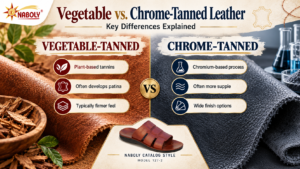
Retail buyers may encounter descriptions such as full-grain, top-grain, genuine leather, and corrected-grain leather.
These terms should not be treated as a universal ranking of product quality.
Our guide to full-grain, top-grain, genuine, and corrected-grain leather explains what these descriptions mean and how they relate to footwear manufacturing.
Ask for Written Specifications
Where available, request a specification sheet identifying:
| Component | Information to Confirm |
|---|---|
| Upper | Material and finish |
| Lining | Material composition |
| Footbed | Materials and design |
| Outsole | Material and construction |
| Stitching | Relevant construction details |
| Fastenings | Buckles, straps, laces, or closures |
| Size range | Available sizes and sizing system |
| Color | Available or proposed finishes |
| Product code | Exact model identification |
This information gives the retailer a clearer basis for comparing samples and approving orders.
5. Use a Physical Sample Inspection Checklist
Samples provide an opportunity to examine footwear beyond catalog photographs.
Where sampling is available, a retailer can assess fit, materials, finishing, and overall construction before considering a larger purchase.
However, sample availability, costs, and quantities must be confirmed with the manufacturer.
Leather Footwear Sample Inspection Checklist
| Inspection Area | What to Examine |
|---|---|
| Upper material | Appearance, flexibility, finish, and consistency |
| Stitching | Alignment, loose threads, and seam quality |
| Sole attachment | Visible gaps, irregularities, or separation |
| Footbed | Shape, comfort, materials, and finishing |
| Heel | Alignment and construction |
| Straps or closures | Attachment security and ease of use |
| Left and right shoes | Size, symmetry, and visible consistency |
| Leather edges | Finishing and potential rough areas |
| Color | Consistency with the approved reference |
| Labels | Model, size, and origin information |
| Packaging | Accuracy, protection, and presentation |
| Overall fit | Length, width, and intended footwear shape |
This is a general visual and fit inspection checklist. It does not replace laboratory testing or an agreed technical inspection protocol.
Compare the Sample Against Its Description
Suppose a supplier describes a sandal as having a particular leather upper and outsole material.
When the sample arrives, confirm whether the product corresponds to the agreed description.
If there are differences, clarify them before approving a larger order.
Compare More Than One Pair When Possible
Inspecting several samples may reveal whether visible materials and workmanship are reasonably consistent.
However, a small sample cannot guarantee how every pair in a later shipment will perform.
Look for Issues That Require Clarification
Examples include:
- Unexpected material substitutions
- Incorrect size labels
- Loose or irregular stitching
- Inconsistent colors
- Uncomfortable strap edges
- Visible sole attachment problems
- Packaging that differs from the agreed specification
Not every natural leather marking is a manufacturing defect.
The distinction depends on the material, finish, location, and agreed workmanship requirements.
For additional practical guidance, read NABOLY’s article on how to tell good leather from bad.
6. Confirm Footwear Sizing Before Approving an Order
International footwear sourcing requires particular attention to sizing.
Manufacturers in different markets may use European, US, UK, or other sizing conventions.
Even when two manufacturers use the same system, their products may fit differently.
Confirm the Original Size System
Ask which sizing system is used for the selected product.
Do not assume that a European size number always corresponds to one specific US size.
Request Product-Specific Measurements
Where possible, ask for:
- Available size range
- Intended foot-length measurements
- Original manufacturer size labels
- Width information
- Fit guidance for individual styles
It is important to distinguish foot length from insole length and internal shoe length.
These are different measurements.
Review Physical Fit
When evaluating samples, consider the shape of the toe box, heel, footbed, and upper.
A sandal with adjustable straps may fit differently from a closed leather loafer carrying a similar size designation.
For a broader explanation of international sizing, see our EU, US, UK, and Middle East shoe size conversion guide.
Prepare the Size Distribution
A size run describes the quantity of each size included in a footwear order.
Retailers should use customer purchase history where possible to determine the appropriate distribution.
Ask the manufacturer whether its ordering requirements allow the proposed size breakdown.
Buyer checklist: Never approve a wholesale size assortment using a generic conversion chart alone.
7. Ask About Manufacturing Capacity and Order Requirements
After identifying suitable products, determine whether the manufacturer can meet the practical needs of your business.
A factory may offer the correct product category but have ordering requirements that do not match your initial budget or inventory plans.
Important Questions About Order Quantities
Ask:
- What is the minimum order quantity?
- Does the minimum apply per model?
- Does each color have a separate minimum?
- Can different sizes be combined?
- Can multiple models be included in one order?
- Are the products currently available?
- Would the order require a new production run?
The answers can affect how you build your assortment.
Understand Production Capacity
If your business expects to place recurring orders, ask whether the manufacturer can discuss its capacity for your selected product categories.
Capacity may be expressed in finished pairs per period, but it is important to understand what the figure represents.
Overall factory capacity does not necessarily indicate availability for a particular product during a particular month.
Discuss Reorders
Your first purchase may be only the beginning of a longer relationship.
Ask how the manufacturer handles repeat orders and whether product specifications or materials may change.
Retailers benefit from knowing when and how they can request future availability information.
Avoid Assuming That Customization Is Included
Custom colors, packaging, branding, or designs may introduce different production requirements.
If you need these options, describe them clearly and request confirmation.
8. Compare Manufacturer Quotations Using the Same Criteria
A useful supplier comparison requires consistent information.
If one manufacturer quotes only a product price while another provides a price including freight, the figures should not be treated as directly comparable.
The same applies when the suppliers offer different materials, products, or quality specifications.
Request a Detailed Quotation
Ask each supplier to identify:
- Exact model or specification
- Unit price
- Currency
- Order quantity
- Packaging
- Payment terms
- Estimated readiness date
- Shipping term and named location
- Freight inclusion or exclusion
- Other charges or conditions
- Quote expiration date
Understand Landed Cost
Landed cost includes the costs of acquiring goods and bringing them to their intended destination.
Consider the following hypothetical comparison.
| Cost Per Pair | Supplier A | Supplier B |
|---|---|---|
| Quoted product price | $31 | $35 |
| Allocated freight | $8 | $5 |
| Illustrative duties and fees | $7 | $6 |
| Other receiving costs | $2 | $2 |
| Illustrative landed cost | $48 | $48 |
All amounts are hypothetical. They are not NABOLY prices, actual U.S. duty rates, or current shipping quotations.
Although Supplier A has a lower starting price, both options have the same estimated landed cost in this example.
The retailer would then need to evaluate other factors, including materials, quality, sizing, service, and delivery.
Don’t Compare Prices Without Comparing Products
Two leather shoes may differ in:
- Leather specifications
- Outsole materials
- Lining
- Construction
- Packaging
- Fit
- Finishing
- Quality requirements
These differences can affect purchasing decisions.
A lower price does not automatically mean the better choice, and a higher price does not automatically guarantee better quality.
9. Evaluate the Manufacturer’s Quality Control Process
A manufacturer should be able to explain how it approaches product quality.
The specific procedures vary depending on the factory, product, and manufacturing arrangement.
For example, quality checks may take place during material selection, cutting, stitching, assembly, finishing, and packing.
Quality Questions to Ask
- How are incoming materials evaluated?
- What construction details are inspected during manufacturing?
- Are finished pairs inspected before packaging?
- How are model numbers and sizes verified?
- How does the factory handle identified production defects?
- Can the buyer agree on inspection criteria for a particular order?
- Is any independent testing required for the intended product?
These questions help establish expectations without assuming every factory follows an identical process.
Define Quality Requirements Before Production
A phrase such as “premium quality footwear” is not sufficient by itself.
Buyers should identify which characteristics matter for the specific order.
For example, an agreed product specification might describe the upper material, finishing, stitching, sole attachment, packaging, and size labeling.
If a particular test or performance claim is important, ask what evidence supports it.
Work Boots Require Additional Verification
Retailers sourcing protective footwear should determine which safety standards, if any, apply to the intended product and market.
Request appropriate documentation for the exact model rather than assuming every work boot meets the same standards.
A manufacturer’s quality management certification does not replace product-specific safety testing.
10. Create a Supplier Evaluation Scorecard
A supplier scorecard allows buyers to compare manufacturers using the same criteria.
It does not eliminate judgment, but it can make the selection process more organized.
Example Footwear Manufacturer Scorecard
| Evaluation Category | Maximum Points |
|---|---|
| Product and material quality | 25 |
| Sizing and sample evaluation | 20 |
| Specification and order documentation | 15 |
| Pricing and landed-cost clarity | 15 |
| Communication and reliability | 15 |
| Production and shipping suitability | 10 |
| Total Possible Score | 100 |
This is an illustrative purchasing tool, not an industry certification or independently validated rating method.
How to Use the Scorecard
Start by defining which requirements are essential for your business.
Then score each manufacturer based on the information you have actually verified.
Avoid giving full points simply because a supplier makes a promising claim.
For example, if a manufacturer states that it uses high-quality leather but does not provide the information you requested, the evaluation should reflect that uncertainty.
Example of Comparing Two Manufacturers
Suppose you evaluate two potential suppliers.
| Category | Supplier A | Supplier B |
|---|---|---|
| Product quality / 25 | 22 | 20 |
| Sizing and samples / 20 | 18 | 15 |
| Documentation / 15 | 12 | 14 |
| Cost clarity / 15 | 12 | 13 |
| Communication / 15 | 13 | 10 |
| Logistics / 10 | 8 | 9 |
| Total | 85/100 | 81/100 |
These figures are fictional.
A higher total may help identify a preferred candidate, but essential requirements should still be treated separately.
For example, a supplier that cannot meet a mandatory safety requirement should not be selected simply because it scores well in other categories.
Practical recommendation: Establish your nonnegotiable requirements before using a scoring system.
11. Recognize Warning Signs Before Placing an Order
Supplier problems are not always obvious from the beginning.
Buyers should pay attention to warning signs that warrant additional verification.
Inconsistent Business Information
If the company name, manufacturing location, or business contact details differ significantly between documents, clarify the discrepancy.
Some businesses legitimately operate under different trading and registered names, but the relationship should be explainable.
Unclear Product Specifications
A supplier that cannot identify essential materials or accurately describe its products may create difficulties during order approval.
Pressure to Pay Without Documentation
Be cautious when asked to transfer substantial funds without a clear written description of what is being purchased.
Unexpected Payment Changes
If bank account information changes, independently confirm the new instructions through a previously verified communication channel.
Unrealistic Production Claims
Very short delivery promises for large or complex orders deserve further discussion.
Ask how the timeline was determined and what conditions apply.
Refusal to Clarify Important Terms
A supplier may have legitimate policies that differ from your preferences.
However, important commercial terms should be explained clearly before a purchase is finalized.
The purpose of these checks is not to assume a manufacturer is unreliable. It is to prevent avoidable misunderstandings.
12. Confirm Shipping Responsibilities and Import Requirements
International footwear purchasing involves logistical and regulatory considerations.
A buyer should understand where the manufacturer’s responsibility ends and where the buyer’s responsibilities begin.
Clarify the Agreed Shipping Term
International transactions may use Incoterms such as EXW, FCA, FOB, DAP, or DDP.
These terms address different responsibilities for costs, transport, and risk.
They are not interchangeable, and some terms are designed for particular types of transport.
Ask which term applies, its named place or port, and what services are included in the supplier’s quotation.
Confirm Customs Classification
U.S. import duties can vary according to the footwear’s materials, construction, origin, and applicable tariff provisions.
Do not assume that every shoe with a leather upper receives the same duty treatment.
Work with an appropriate customs professional to determine the requirements for the actual product.
Review Origin and Labeling Requirements
Ask the manufacturer for accurate information about the country of origin of the finished footwear and any required product markings.
A manufacturer’s location alone does not establish the correct legal origin for every possible product.
Prepare for Import Documentation
Depending on the shipment, the importer may require a commercial invoice, packing list, transportation records, classification information, and other applicable documentation.
Agree on document responsibilities before the shipment is prepared.
Build a Realistic Timeline
Work backward from the date you need the inventory in your store.
Allow for:
- Product availability or manufacturing
- Final inspection
- Packaging
- Freight arrangements
- Transportation
- Customs processing
- Domestic delivery
- Receiving and inventory checks
The time required can differ from one order to another.
A promised manufacturing completion date is not necessarily the same as a guaranteed in-store delivery date.
13. Review the Purchase Order Before Making Payment
Once you have selected a supplier and approved the proposed products, make sure the agreement accurately reflects what you intend to buy.
A written purchase order or equivalent confirmation should identify the important details.
Wholesale Footwear Purchase Order Checklist
| Information | Confirm Before Approval |
|---|---|
| Buyer and seller | Correct business names |
| Model numbers | Exact footwear styles |
| Quantities | Total and per-model amounts |
| Size runs | Quantity for each size |
| Colors | Approved color selections |
| Materials | Agreed specifications |
| Packaging | Boxes, labels, and carton details |
| Unit prices | Correct amounts and currency |
| Total price | Agreed purchase value |
| Payment terms | Amounts, timing, and method |
| Shipping terms | Responsibilities and named location |
| Readiness date | Agreed production or dispatch expectations |
| Quality requirements | Inspection and approval criteria |
| Claims procedure | How shortages or defects are reported |
If information is missing, clarify it before confirming the order.
Why Written Confirmation Matters
Verbal discussions are useful, but complex purchasing arrangements can be difficult to remember accurately.
Written confirmation reduces the possibility of disagreement about quantities, sizes, materials, and commercial terms.
For information specific to NABOLY’s published ordering process, see our guide to ordering NABOLY footwear for your shop.
14. Inspect the Shipment When Your Shoes Arrive
Receiving the shipment is not the end of the purchasing process.
Retailers should compare what arrived with the confirmed order.
Receiving Inspection Checklist
Check the carton count. Compare the received cartons with the relevant shipping documents.
Verify quantities. Count the pairs or use an agreed receiving verification process.
Compare model numbers. Confirm that the shipment contains the selected footwear.
Review size distributions. Check whether the correct quantities were supplied in each size.
Inspect visible condition. Look for damaged packaging and signs of problems with the merchandise.
Compare against samples. Where an approved sample was part of the agreement, use it as an appropriate reference.
Document problems. Record discrepancies with photographs and written notes.
Follow the agreed claims procedure. Report any concerns within the applicable time limits.
Why Receiving Records Are Useful
Clear receiving records can help retailers identify inventory discrepancies and communicate with suppliers.
They also provide information for future purchases.
For example, if customers repeatedly report that a particular model fits differently from its published sizing information, record that feedback and discuss it before placing another order.
15. How to Build a Long-Term Relationship With a Footwear Manufacturer
A successful first purchase can become the foundation for an ongoing supply relationship.
However, the value of a supplier relationship should be reviewed over time.
Retailers should evaluate whether the manufacturer continues to meet agreed product and service requirements.
Track Supplier Performance
Useful indicators may include:
- Order accuracy
- Actual versus agreed readiness dates
- Product consistency
- Communication quality
- Document accuracy
- Frequency and resolution of claims
- Customer feedback about the footwear
Share Retail Feedback
A manufacturer may benefit from learning how its products perform in the buyer’s market.
For example, a retailer might report that certain sandal sizes sell quickly or that customers prefer a particular upper design.
This feedback may help future product and inventory discussions.
Review Changes Before Reordering
Do not assume all product specifications and commercial terms will remain unchanged.
Confirm relevant details with each new purchase.
A well-managed supplier relationship combines ongoing communication with clear documentation.
16. Why Consider a Leather Footwear Manufacturer in Hebron, Palestine?
Hebron has a longstanding footwear manufacturing tradition.
The city developed an interconnected network of shoemakers, leatherworkers, suppliers, and production businesses over generations.
For retailers looking beyond conventional sourcing markets, understanding Hebron’s footwear history provides useful context.
Our article on Hebron’s shoemaking heritage explores how the city became an important center of Palestinian footwear production.
NABOLY’s Manufacturing Background
NABOLY is a family-rooted footwear manufacturer based in Hebron, Palestine, with a company history dating to 1948.
The company describes the production of leather footwear in its own manufacturing facility and maintains collections covering sandals, loafers, casual shoes, dress shoes, and boots.
NABOLY’s published materials also describe its experience serving domestic and international markets.
You can learn more about its production background through the NABOLY Shoe Manufacturing page.
How Retailers Can Begin Evaluating NABOLY
Start by reviewing products in the company’s catalog.
Identify models that match your store’s customer base.
Then prepare an inquiry describing your intended footwear categories, quantities, market, and relevant questions.
The team can discuss available products and provide information about applicable ordering arrangements.
As with any manufacturer, the buyer should confirm specifications, samples, commercial terms, and shipping responsibilities before making a purchasing commitment.
Frequently Asked Questions About Sourcing Leather Shoes
How do I find a reliable leather shoe manufacturer?
Start with manufacturers that produce your intended footwear category. Verify the business identity, review actual products, request relevant specifications, examine samples where available, and confirm the purchasing terms before placing an order.
What should I ask a shoe manufacturer before buying wholesale?
Ask about manufacturing capabilities, product materials, available styles, size ranges, minimum orders, pricing, sample arrangements, quality checks, payment terms, and shipping responsibilities.
Is it better to buy leather shoes from a manufacturer or a distributor?
Both options can be appropriate. A manufacturer may provide more direct access to production information, while a distributor may offer different inventory or fulfillment arrangements. Compare total costs, products, and services.
Can small shoe stores source footwear directly from factories?
Small retailers can contact manufacturers directly, but available purchasing arrangements depend on the supplier’s product selection, minimum quantities, and commercial terms.
How can I check whether a footwear manufacturer is legitimate?
Verify the company’s identity, address, manufacturing role, relevant credentials, and communication channels. Request supporting information and independently confirm important details where appropriate.
What is the best way to check leather shoe quality?
Review documented material specifications and physically examine samples where available. Evaluate the upper, lining, sole, stitching, sizing, finishing, and construction. Specialized performance claims may require testing.
Should I request shoe samples before placing a bulk order?
Samples are useful for checking materials, fit, and workmanship. Ask about sample availability and terms before requesting them.
How do I compare footwear manufacturing quotations?
Compare the same or closely equivalent product specifications and calculate the estimated landed cost under comparable shipping arrangements. Consider quality, communication, and production suitability alongside price.
What is the minimum order quantity for direct footwear manufacturing?
There is no universal minimum. Requirements vary by manufacturer, model, color, production arrangement, and other commercial factors.
How do I confirm that shoe sizes will work for U.S. customers?
Request the manufacturer’s product-specific sizing information, confirm the original size system, and examine samples when possible. General EU-to-US conversion charts are approximate.
Can manufacturers produce custom leather shoes?
Some manufacturers offer custom designs, colors, or branding, but these capabilities should not be assumed. Buyers should submit detailed requests and confirm availability, development requirements, quantities, and costs.
What documents should I receive with an international footwear order?
Documentation may include a commercial invoice, packing list, transportation records, and additional information required for customs processing. Exact requirements depend on the shipment and applicable rules.
How do I avoid problems when importing shoes?
Clarify responsibilities, verify product information and origin, confirm customs requirements, document commercial terms, and use appropriate freight and customs professionals when necessary.
Can I source leather footwear directly from NABOLY in Palestine?
NABOLY welcomes wholesale inquiries from retailers, distributors, and other businesses interested in its footwear collections. The company can discuss available products and applicable purchasing arrangements.
Final Checklist: Are You Ready to Choose a Shoe Manufacturer?
Before making your final sourcing decision, confirm that you can answer the following questions.
| Final Question | What You Should Have |
|---|---|
| Who produces the footwear? | Verified manufacturer information |
| What products are available? | Catalog and model specifications |
| What materials are used? | Appropriate product descriptions |
| Have samples been evaluated? | Inspection notes or documented approval |
| Are sizes understood? | Product-specific size information |
| Are quantities confirmed? | Model, color, and size breakdown |
| Is the price clear? | Written quotation |
| Have total costs been considered? | Estimated landed-cost calculation |
| Is quality documented? | Agreed quality expectations |
| Is the timeline realistic? | Written readiness and shipping information |
| Are payment responsibilities clear? | Confirmed commercial terms |
| Is import preparation complete? | Applicable documentation and arrangements |
| Are problem-resolution procedures understood? | Agreed claims or defect process |
If important information remains unclear, ask the manufacturer for clarification before making a purchasing commitment.
The purpose of a good sourcing process is not simply to find someone willing to sell shoes.
It is to establish that the supplier can deliver the specific products your business needs under terms you understand.
About NABOLY: Leather Footwear Manufacturing in Hebron, Palestine
NABOLY is a Palestinian footwear manufacturer with a family manufacturing history dating to 1948.
Based in Hebron, the company produces leather footwear and maintains collections that include sandals, slip-ons, loafers, dress shoes, casual shoes, and boots.
Our manufacturing heritage reflects generations of footwear experience and the continuing development of shoe production in Hebron.
Retailers interested in learning more about NABOLY can explore the company’s product catalog and manufacturing information before submitting an inquiry.
Looking for a Leather Shoe Manufacturer for Your Business?
If you’re an independent shoe store owner, boutique retailer, distributor, or footwear buyer, NABOLY welcomes your inquiry.
Tell us which footwear collections interest you, your estimated order quantities, and the market you serve.
Our team can review your requirements and discuss available products, purchasing information, and the next steps.
Contact NABOLY About Wholesale Leather Footwear
Written by the NABOLY Team — Leather Footwear Manufacturing in Hebron, Palestine.